
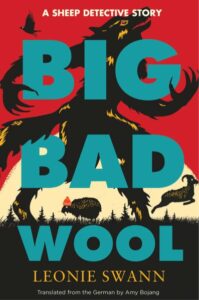
 Translated by Amy Bojang
Soho
Published May 6, 2025
Reviewed by Barbara Fister
The flock of sheep first encountered in Three Bags Full (2008) has a new mystery to solve. They have moved from Ireland, where they investigated the murder of their beloved shepherd, George, to a French chateau, tended by a new shepherd: George’s daughter Rebecca. They are beginning to get used to their new meadow as they overwinter beside a deep, dark forest and a herd of sarcastic goats, but they begin to realize something is wrong with this place. After one of the sheep disappears into the forest and men with dogs find slaughtered deer in the woods, they overhear a woman tell Rebecca they should leave the chateau immediately. A small black goat lets them in on some local lore: The woods are haunted by the Garou, a werewolf. And all of the sheep who lived in the meadow before them met a gristly end.
This threat propels the sheep into a series of adventures. The flock finds a body near Rebecca’s caravan and hide it under the snow, worried their shepherd will be blamed. A strange, woolly beast has joined them, a sheep with an overgrown coat and a habit of calling out to ghostly sheep who aren’t there. The youngest of the flock, too young to have been given a name yet, teams up with the adventurous young goat to seek clues in the forest, three of the sheep hitch a ride in the back of a truck and become hopelessly lost, while others sneak into the chateau to uncover its secrets. But the ultimate goal is to find the Garou – or, if the Garou is really a human being pretending to be a werewolf, to discover which of the strange humans at the chateau is playing that role. Their lives, and Rebecca’s, depend on it.
It’s hard to describe this book. It’s funny, strange, often weirdly poetic, and frequently confusing. There is no effort to tell the story as a traditional crime story, with clear-cut clues and a parade of suspects. We have to put the pieces together as we experience events from the perspective of the sheep, who do their best to make sense of what the humans are up to as they “honk” at each other in strange European lingo, but their interpretations are often askew.
To add to the readers’ challenge, there are many characters, so many there is not only a helpful list of Dramatis Personae provided, but a list of Dramatis Oves, Caprae, and Canidae. Luckily the Oves (the sheep) are given such distinctive characters they are easy to get to know.
And getting to know them is delightful, providing readers an entertaining, sheepish perspective on the world and its strange inhabitants through a narrative that is fresh and surprising.