
 Soho
Published February 24, 2026
Reviewed by Barbara Fister
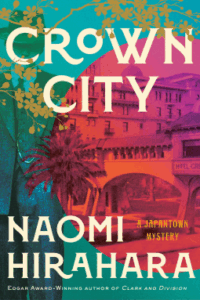
For many years, Naomi Hirahara has been revealing the lives of Japanese Americans to readers who have much to learn. Recently, she published two mysteries about a family whose forced removal to an internment camp during World War II changed their lives, and how even after returning to California they experienced a cascade of injustices–all while relating a captivating story with memorable characters. In her third “Japantown” mystery, she does it again, only this time moving the action to an earlier time period, 1903, as a young man, Ryunosuke Wada (nicknamed Ryui and later renamed Louie by an American woman) trained as a skilled carpenter by his exacting artisan father. He leaves Yokohama after his father’s death to work for an importer of Japanese art in Pasadena, where a popular Japanese artist, Toshio Ayoki, has created a market for those enamored of Japanese culture, if not of Japanese people themselves. There, sharing a boardinghouse room with another Japanese immigrant who is a talented photographer, he learns his way around “Crown City” and American ways, until a mystery comes his way–the first of several.
Someone has stolen a painting by the renowned Japanese artist, who hires the roommates to find it. While they go about this work, fashioning themselves as private investigators, another inhabitant of the roominghouse, the fetching and personable young woman who gave Ryui his Americanized name, asks him to track down a former resident who borrowed money from her and then disappeared. There is also the fallout of an archery competition that leads to an unfortunate attack on one of the contestants’ hat and dignity. All of these, along with repairing wooden furniture, helping out at the shop, assisting with an embarrassing dinner hosted for wealthy women besotted with Japanese culture, and eventually solving a murder keep him busy.
What is most fascinating about this novel is seeing a young man raised by a respected artisan in Meiji Restoration Japan travel to America, learning about its culture and seeking his place in it. His observations and comparisons are eye-opening for those of us who know little beyond the bare bones of the Japanese American experience. It’s an important lesson in understanding at a time when anti-immigrant feelings mirror those of the early twentieth century, when the nation grappled with its identity and the role of immigration in it.
Beyond that educational benefit, one that continues from the previous books in the series to which this story is loosely linked, the book is simply great fun, with a vivid cast of characters and a brilliant sense of place – or places, both Ryui’s native country experiencing great changes as it opened to the West, and of a city in California experiencing a similar time of cultural upheaval. Thanks to the author’s note, we learn many of the characters in the book are historical figures, making it all an even more informative journey for readers.
Crown City evokes a fertile collision of cultures at a moment in history, all wrapped up in a ripping good yarn.