
 Mariner
Published September 30, 2025
Reviewed by Mary-Jane Oltarzewski
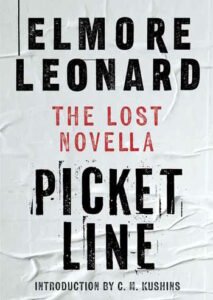
Picket Line, Elmore Leonard’s long-lost, recently rediscovered novella, is a tiny, valuable thing: not a gem, exactly, because Leonard’s words don’t sparkle; there’s never been anything gaudy or colorful about his prose. The most extraordinary thing about his work is how he achieved maximum impact with minimum language. He didn’t so much describe people, as cut them loose and let them react to one another, so that the reader could figure out what they were up to. His output, primarily Westerns and crime fiction, appeared as novels, short stories, screenplays, and teleplays, all featuring propulsive plots and memorable characters. Leonard wrote Picket Line in 1970, repurposed some of the characters and part of the plot into a screenplay that became Mr. Majestyk, a fairly profitable 1974 action film, and in 2000, submitted the original to a digital media start-up that went belly-up before releasing the e-text. It remained unpublished and unseen until this year.
Picket Line looks and sounds like a western. Set in Texas farm country, it involves cops, convicts and crimes. More importantly, however, it packs questions of class, race, gender, Marxism and capitalism, spirituality and conscience into a tight little narrative about union activists seeking to organize a strike, in order to achieve higher pay and better working conditions for migrant laborers at a melon farm. The laborers, mostly Chicanos, are working in the summer heat for the same reason: to scrape out a meager living, while the profits go mostly to the farm owner, a gringo who is never seen nor heard from.
Opinions vary regarding the union. A young Black man named Clinton Taylor says “ ‘They always somebody want to save you.’” Bud Davis, a white college student on summer break, says, “ ‘I come here to work, and the first thing I know there’s a strike on.’” Still, Davis observes, “There were farmworkers on strike and workers still in the fields, so there had to be two sides to it. Or more, counting the growers.” Larry Mendoza is a former melon picker who “was making a buck sixty now as foreman, all year, and drove a pickup truck and his family lived in a house with an inside toilet.” He is impatient with the picketers (“nobody was paying them a dollar ten cents an hour to rest,”) for different reasons than the cops are.
Patrolman Harold Ritchie, who fought in Vietnam alongside the grandson of one of the laborers (“They had not been close friends, though they had been close the day he carried the grandson’s dead body out of the DMZ”) genuinely believes he’s been “assigned to watch the pickets and keep order,” and is trying to figure out why people he’s known all his life are so angry at him. Other police stand by and watch, as a foreman runs into a striker with his pickup truck, breaking the man’s leg. His captain justifies this: “ ‘you congregate out here like a mob, we’ll arrest you for unlawful assembly, inciting to riot, causing a disturbance or anything we feel we can make stick.’”
The union activists, likewise, have varied motivations. Connie Chavez – “twenty, with two and a half years of college behind her and years of working in the fields behind that” – is angry at the cops, at the landowner, at Bud Davis (“’how does it feel, Anglo, to take a poor man’s job?’”). Angrily, she calls Mendoza “Judas” and he calls her a whore. She wants a revolution. Paco and Chino, a couple of ex-cons who have done time for violent confrontations at other union actions, in other towns, are angry at the system and want a war: they don’t see any other option. However they all respect Vincent Mora, soft-spoken veteran organizer who appeals to the workers’ sense of dignity, in order to coax them out of the fields and onto the picket line. “‘You think a dollar ten cents is better than nothing?’” he asks. “‘If you do, that’s the value you put on your self-respect.’” Trying to be less angry, more patient, Mora tells Chino “ ‘You see this as busting a grower. I want him to recognize a union'”. He believes that “‘once a man walks out of the field and joins a picket line, he’s never the same again.’”
Tension among all these viewpoints builds, right to the last moment, but in the end, Leonard makes it clear that there’s really no way to solve the crimes, or determine who’s right. There’s just people reacting to one another, so the reader can figure out what they’re up to.