
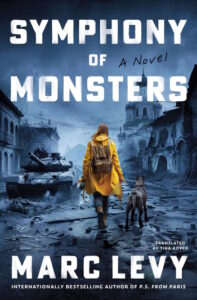
 Translated by Tina Kover
HarperVia
Published January January 20, 2026
Reviewed by Barbara Fister
In an occupied area of Ukraine, a family struggles to maintain their lives. The father is away at war, the mother Veronika is a nurse in a busy, underfunded clinic. Her teenage daughter Lilya resents her mother’s long days and doesn’t always get along with her brother, nine-year-old Valentyn who is nonverbal but unusually bright. One day, Valentyn notices some strangers hanging around his school, and writes a note to a trusted teacher to alert her. By the time buses pull up and Russian authorities enter the school to kidnap the children, the teachers have helped them escape capture – apart from Valentyn who stayed back to help a disabled girl and one other boy. The boys are carried away to a Russian orphanage, just two of the many thousands of children who have been abducted. Valentyn’s attempts to escape, and his family’s efforts to find him, propel this timely thriller.
The plot unfolds from three points of view: Valentyn’s experience in the orphanage, where hundreds of children are being brainwashed and readied for adoption by Russian families, paid to participate in the genocidal program; Lilya’s impulsive attempt to locate the orphanage, cross into Russia, and figure out some way to help him escape; and Veronika’s desperate attempts to save them both. Added to the roster are a Kiev-based hacker and his associates, busy infiltrating Russian cyber systems to aid the war effort. They are mobilized to help rescue the boy using high-level information and their connections to resistance fighters working within Russia to undermine the enemy. The stakes grow higher when the mastermind of the kidnapping program, a close associate of Putin, notices the unusually bright child and selects him to star in her propaganda efforts.
The pace of the novel is non-stop and the twists and turns keep the pages flying. There’s something childlike about the story – not that it’s written for children (though it certainly would be appropriate for a young adult audience), but that it draws such distinct lines between the brave Ukrainians and the evil, all-powerful Russians. Of the hundreds of abducted children at the orphanage, only Valentyn seems to resist indoctrination. Not only do the Russians have complete control over them, they appear to have unlimited resources to run their scheme.
There is only one point when the narrative is complicated by an ambivalent character: while on her quest, Lilya encounters a grandmotherly woman who feeds and comforts her, but also talks about how foolish it is to go to war when being part of Russia and surrendering Ukrainian culture would be so much better than independence. Otherwise, there’s not much subtlety in the way the monstrous situation is portrayed, and while the primary characters are engaging and fairly well drawn, the supporting roles are less developed.
Using a real-life atrocity to spin up an entertaining thriller is a complicated task, and Marc Levy isn’t entirely up to it as far as portraying a grim reality. That said, many readers who may be at best only vaguely aware the mass kidnappings that Russia has committed will be made aware of the situation by this novel. If that information comes in the form of a fast-paced and hopeful thriller, that may be more effective at making people care than any number of news reports.