
 Linda Leith Publishing/Literary Press Group of Canada
Published September 5, 2026
Reviewed by Barbara Fister
While murder isn’t completely uncommon in Winnipeg, the identity of the body confronting Detective Michael Shelter is unusual. The victim, found with his throat slit in an upscale vacation rental, must be a Hutterite, to go by his traditional clothing. While Manitoba is home to many members of this Anabaptist sect, they live apart from modern society in agrarian communities and are strictly pacifists. They don’t generally get themselves murdered in the city. Shelter will have his work cut out for him, teasing out what happened and who is responsible.
With his partner he is able to uncover a few leads. It turns out the murder victim had arranged to meet a man he’d known years ago, when they both left the strict sect for modern life. Though he had returned to the Hutterite community, got married, and had children he had reconnected with the past friend who now was the director of a prominent art gallery. They had embarked on an affair that violated Hutterite strictures. The gallery director and his jealous husband were suspects, as was the man living on a farm the Hutterites were trying to purchase. The legal owner of the farm, his estranged brother, had sold it but the man had refused to leave, setting up a conflict that the Hutterites were trying unsuccessfully to resolve without involving the authorities. Or could it be the sketchy friend of the farmer who had a record of selling drugs, or someone handling the millions of dollars involved in the purchase of land? Then again, it could it be the act of another member of the Hutterite community, which while pacifist was not without subsumed conflict.
It’s a difficult case, and getting to speak to Hutterites who knew the victim is tricky, controlled entirely by the leader of the sect, which as a whole wants little to do with the outside world. Shelter has another issue interfering with his investigation: He’s experiencing weird moments of dizziness, has trouble keeping his temper, and can’t sleep at night, haunted by dreams of a shooting. It’s not only affecting his work, it has led to a breakup with his long-term girlfriend. His partner advises him to see a doctor, but he resists doing what he knows he should do, and he takes risks he shouldn’t.
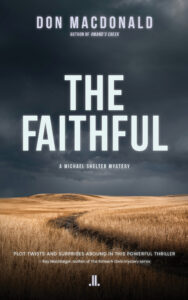
The Faithful does a good job of juggling these elements, following a frustrating investigation while offering insight into a distinctive community that lives, as much as possible, as they have for five hundred years. Though bearing some similarity to the Amish in their aloofness from modern life, they live in communal fashion, sharing the work of managing large farms, dining together, and keeping gender roles strictly and separately defined, all watched over by a benign but implacable leadership. The author doesn’t romanticize the life style, but shows both its positive features and its oppressive side. He also explores the ambivalent relationship between the Hutterites and local farmers who are understandably resentful that their successful neighbors have the resources to buy up so much land it shuts out other farmers who want to expand or start a farm.
The author also provides descriptive touches that convey the austere beauty of the vast prairie landscape and the lonely town swallowed up in it. With an interesting setting and a well-paced plot, Shelter’s Manitoba is well worth a visit.