
Atria 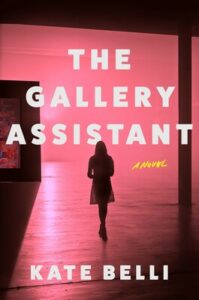
Published October 14, 2025
Reviewed by Barbara Fister
Chloe Harlow has landed a job as an assistant at a New York art gallery, discovering that she has a talent for researching artworks even though she’s never before had a professional job and dropped out of college. But when the up-and-coming contemporary artist who recently signed with the gallery is killed, Chloe is caught in the middle of something she doesn’t understand. Though she was at a party at the artist’s studio shortly before the murder, she was drinking with abandon and has no memory of how the evening ended, or how she ended up at home in bed. When the police come to the gallery to ask about it, she tries to cover up the truth, but it has a way of coming out, and soon she wonders if she’s a suspect.
Bit by bit, memories resurface, fragments that don’t cohere, and what little she knows doesn’t match up with what people tell her. In the meantime, things are getting strange at the gallery. Her mentor and boss is suddenly fired, and when she tries to find him at home she discovers his apartment is empty, with no sign of his past existence. She’s given a more responsible role at the gallery, one she’s really not qualified for, but it gives her a chance to immerse herself in the murdered artist’s paintings – which is when she realizes, buried in the thick paint and barely visible, there is a message: help me.
The plot is unfolded with an increasingly strong sense of paranoia, along with the possibility that Chloe’s grip on reality is slipping. Has someone searched her apartment? Is she being followed? Or is her anxiety all part of the trauma she experienced at the World Trade Center when she nearly died in a cloud of dust just a few months before the artist’s murder? It takes time for the reader to warm up to the protagonist – she drinks too much, she sleeps around, she’s late for work, she’s a mess. But gradually we get to know her as she begins to see in art something profound and meaningful just as we learn more about why she is such a mess. By the end, we’re firmly on her side as she untangles the mysteries surrounding the murder and the dark side of the gallery business.
It’s a cleverly wrought story that starts out at a leisurely pace that ramps up as the sense of danger increases, but what sets it apart is the loving portrait of New York City at a time of tragedy and resilience as well as the invitation the author gives us to see art through Chloe’s untutored but insightful eye.