
 Soho Press
Published April 1, 2025
Reviewed by Barbara Fister
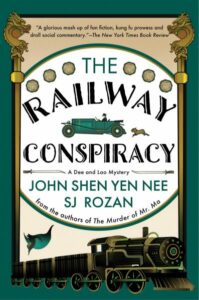
In 1924, a White Russian agitator and a Japanese martial artist wielding a samurai sword meet in Richmond Park, London, to make an exchange. But before the Russian can hand over a valuable artifact, a dragon taming mace, the transfer is interrupted by a quartet, first encountered in The Murder of Mr Ma (2024). Judge Dee Ren Jie, recently returned from China on a secret mission, has once again disguised himself as a dime novel hero, Springheel Jack, in order to recover the mace for its rightful owner. Aided by his loyal assistants merchant Hoong, young pickpocket Jimmy Fingers, and academic Lao She, the theft is thwarted and the mace is returned to Wu Zie Tian, a wealthy and beautiful Chinese businesswoman living in Mayfair.
She invites Dee and Lao to a dinner party where they meet a powerful English banker. As guests discuss the future of a China riven by political violence, Lao girds himself to make a case for communism against the general belief that a nationalist government would be China’s best hope. A few days later, the banker is found dead – poisoned – and it’s only the first murder. Someone is determined to shape the future of China and control of the Chinese Eastern Railway, a rail line that White Russians, Soviet Russians, and Japan all hope to control, is rumored to be at the heart of a conspiracy.
This series, co-written by a seasoned mystery writer and a comic book publishing executive, is a curious mashup of cultural references. It joins the ranks of Sherlock Holmes pastiches, with Lao She playing the role of Watson, his shy, scholarly and somewhat dim nature a foil for the brilliant detective Dee. It also builds on the Gong’an fiction tradition, particularly from the last imperial Chinese era when puzzles solved by wise officials were joined with martial arts heroics. Westerners are largely unfamiliar with this centuries-old Chinese genre, apart from stories written by Dutch author Robert Van Gulik, who translated an eighteenth-century Gong’an novel and then wrote a series of his own with Judge Dee as his Holmsesian hero. This reinvented Judge Dee series also plays with “yellow menace” movie tropes and draws on more-recent martial arts films.
An additional element of the series, and perhaps its most compelling feature, is the way it highlights elements of early twentieth-century Chinese history and examines how Europeans interacted with Asian immigrants. In this case, the conflict is about who will win control of a vast country. It may seem to readers less emotionally engaging than the subject matter of the first book in the series: the use (and abuse) of Chinese laborers by European powers during and after World War I. The human toll of the political conflict is not as vividly woven into this story, and the frequent choreographed fight scenes may tire those who are not fans of martial arts films.
That said, it’s a creative exploration of genres in collision and an entertaining romp. It will be interesting to see where this series takes us next, and what we will learn about China during a period of upheaval and transition that many of us know very little about, but which has had an indelible impact on the present day.