
 St. Martin’s
Published August 4, 2026
Reviewed by Barbara Fister
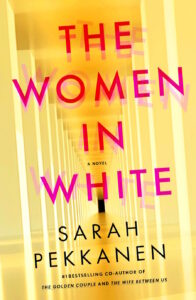
Riley is sleeping in her car and desperate for a place to live and a better job than her low-wage nurse’s aid position after her ex-husband’s gambling addiction left her homeless and penniless. Being a live-in caregiver for an elderly disabled widow named Betty seems an ideal possibility, though there’s something odd about the place: It seems to be stuck in the mid-1960s, without television or the internet. Betty hasn’t gone out in decades, and doesn’t know anything about the world that has evolved outside her small house. Yet Riley soon learns Betty is in many ways unusually perceptive. In fact, she has a gift that was exploited by an obsessed and cruel scientist who experimented on her and three other young women during the cold war, testing them for extrasensory perception and other psychic skills that he’s certain will make him famous. Something went badly wrong with the program, leading to Betty and her husband fleeing from the university where the experiments were conducted and to hide from the outside world. But someone, it seems, is starting the research program again, and Betty is once again in danger.
The narrative jumps around in time, dwelling at length on the experiences of the four women who are experimental subjects on a university campus in the 1960s, sometimes jumping further back to their childhoods, and often forward in time to the present, as Riley tries to find out what happened and who is currently after Betty’s secrets. The experiments begin with benign puzzles the scientist uses to identify good research subjects, women with unusual gifts for mental telepathy, but progress into more and more demanding and difficult tasks, eventually becoming brutally abusive. Meanwhile the women, who grow increasingly close to one another, have challenging home lives, trying to fit their time in the laboratory around homemaking duties – greeting their husbands with a cocktail and a well-prepared dinner in a spotless home. In the present time, Betty’s unfamiliarity with the modern world is matched by Riley’s mystification by her stories of the patriarchal past. But they connect with one another, mirroring the friendship of the women who were under the thumb of a sadistic researcher.
The puzzle pieces fit together through short chapters and increasingly fraught situations for the women in white, as well as for Betty in the present, as the past threatens to resurface. The end result is a compulsively readable, if often rather implausible, story. (How could a woman in her eighties live such an isolated life that she had never seen a smartphone? Why would women in the sixties, however oppressed in a patriarchal society, put up with the treatment they got as volunteers for a deeply unpleasant and demanding scientist?) But the story, inspired by actual parapsychology experiments that were widespread during the cold war, is compelling enough to make it worthwhile for readers to suspend disbelief.