
 Harper Perennial
Published May 5, 2026
Reviewed by Barbara Fister
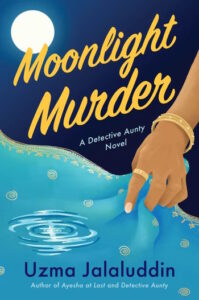
In the second volume of the “Detective Aunty” series, Kausar Khan has moved back to the Golden Crescent neighborhood of Toronto to be closer to her daughter and granddaughters. She has filled a closet of her new unfurnished apartment with boxes of records from her son’s hit-and-run death some two decades ago, a death that had sent her into a tailspin of depression. Now she feels almost ready to start opening the boxes and begin an investigation into what really happened that night, but first her granddaughter comes to her with a more recent mystery. A boy at her school has been found dead in a local pond, after an overdose. The authorities think it’s a suicide, but Maleeha is convinced he would not kill himself. Nor would he take drugs. Something suspicious led to the death, and she wants her grandmother, who has already earned a reputation as a sleuth, to find out what really happened.
The two cases unfold in tandem, with the help of Kausar’s good friend May and Nasir Hafeez, who clearly would like to be more than friends, but who respects Kausar’s wish to keep her independence. She had been married, as was the custom among Indian Muslims of her generation, to an older man whom she had never met, and while it had been a happy union, she was exploring the feeling of living on her own terms for the first time in her life. Bit by bit, Kausar assembles fragments of information about the night her son died and the circumstances that led to Maleeha’s friend’s death, visiting with teachers at their school who led a poetry club, and tracking down anyone who might have information about why her son was on an unfamiliar street the night he was hit by a car. Though the solution to both mysteries seems a leap of faith, the author has played fair and sprinkled clues throughout the story, though few readers would be able to put them together quite the way Kausar does.
Though set in an urban area, there’s something of the feeling of a small-town mystery in this cozy-but-not-too-cute series. The fictional neighborhood of Golden Crescent is largely inhabited by immigrants from the Indian subcontinent, and they tend to know one another through the mosque, the public school, and business relationships. Part of the charm of the series is being invited into this close-knit community, where challenging events are often met with a quote from the Koran or the Hadith and where tradition and contemporary Canadian life coexist comfortably. Kausar’s quest for self-discovery late in life is nicely drawn, as are the family members and surrounding figures, including a shambolic lost teen and a cold and scary father who lives a modest life but is connected to the criminal underworld.
Some read for plot, some for characters, others for the way it all is woven together with stylish writing; here there’s something for all kinds of readers, a well-balanced mix of all of the ingredients that make for a good mystery. Readers will be left eager for Kausar’s next adventure.