
 St. Martin’s
Published April 14, 2026
Reviewed by Meredith Frazier
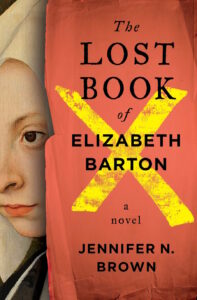
Part historical mystery and part cozy murder-mystery, Jennifer N. Brown’s The Lost Book of Elizabeth Barton doesn’t strictly conform to the “rules” of either form but is, nonetheless, a compelling hybrid with much to recommend it. And while no murder occurs until about three-quarters of the way through the book, there’s plenty of foreshadowing to keep the pages turning.
Told in chapters that alternate between the present day and the early 1500s, the story revolves around Elizabeth Barton, also known as The Holy Maid of Kent. She was Catholic woman who had visions and prophesied the death of Henry VIII if he divorced Catherine of Aragon and married Anne Boleyn. Of course, this didn’t go over well, and the book opens with Barton’s hanging. But subsequent chapters flashback to take the reader through Barton’s life of visions and fame and all that led to her hanging, including Brown’s speculation about Barton’s manipulation by the powerful men who surrounded her. That speculation is voiced through the present-day fictional historian Alison Sage who discovers a copy of the book that gives this novel its title. Sage’s discovery leads to an invitation to a very exclusive consortium at a country house connected to Barton’s convent, and there, academic jealousy, financial greed, a treasure hunt, and murder ensue, and Sage finds herself in the middle of current-day manipulations that threaten her very life.
Jennifer N. Brown is an English professor who specializes in medieval literature written for and by women, and her research expertise shows in her fiction debut. Elizabeth Barton and her world are thoroughly captured, as are Alison Sage and the world of academia. But don’t be put off by the academic qualifications—this is a very readable work of fiction, in spite of the real historical events it imagines and portrays so well. And while the present-day murder comes late in the book, that’s not a drawback: the world-building leading to the murder is intriguing enough to maintain interest and makes the murder itself all the more believable when it does happen. There are a few scenes toward the conclusion of the present-day mystery that do need an extra bit of suspension of disbelief, but the bulk of the book is such a pleasure for those who are fascinated by the lives of historical figures and academic treasure hunts, the somewhat farfetched scenes are fairly easily forgiven. In the end, though, The Lost Book of Elizabeth Barton is more likely to be enjoyed for its historical and treasure-hunt elements than for its murder-mystery attributes.