
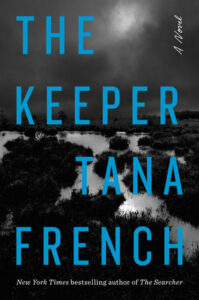
 Viking
Published March 31, 2026
Reviewed by Barbara Fister
Some novels are described as “slow burns.” Tana French’s third (and final) book in the Cal Hooper series doesn’t seem to burn at all. The fires are all underground, deep in the peat, where they’ve been smoldering for decades. Cal Hooper, a retired Chicago cop who bought a tumble-down house on the outskirts of Ardnakelty, a small farming village in Ireland, is beginning to feel at home. The townsfolk have warmed to the stranger, and he’s able to swap stories with the men at a local pub. His relationship with Trey, a child from a troubled home who he has befriended and mentors, seems to be coping without outbursts of rage and even has made some friends. And he has grown closer to Lena, a woman who keeps herself aloof from the village but has become his close companion. That sense of peace and belonging is threatened when a young woman, engaged to the son of a local businessman, goes missing one night, only to be found drowned in the river shortly after she spoke to Lena, clearly struggling with something on her mind. Accident or suicide? Or did something more sinister lead to her death?
Cal left his law enforcement identity behind, but can’t help but dig into the questions that linger. Trey is certain something evil happened to the woman, and both he and Lena feel they owe it to her to not let it go, but it puts them in the crosshairs of the powerful businessman, Tommy Moynihan. He has brought jobs to the town, though at the expense of traditional farm life; now he’s buying up parcels of land here and there. For some, whose children aren’t interested in staying on the land, his developments offer a future, but for Cal’s neighbor Mart, he’s threatening a way of life.
While Tommy has a lot of money and the confidence to go with it, Mart has a stubborn, hidden kind of influence in the village. Both men know how to put on pressure while seeming benign. “Rumor is one of Ardnakelty’s primary weapons,” Cal realizes. Lena warns him that he’ll find himself caught in a power struggle if he’s not careful, but once Tommy finds ways to threaten him and, more importantly, Trey’s family, he feels he has to find out why a young woman died, and if Tommy or his obnoxious son is responsible.
Few writers approach crime fiction with such subtle character development and lyrical imagery as French. For those looking for pacey plotting and thrills, this may be a drawback, particularly if they come to this novel without having read the previous two. But for those who are willing to sink into this world, it’s immersive. Her descriptions are vivid. On a hazy winter day, “the greens fade into grays towards the horizon, like the fields are slowly turning to stone.” When Lena goes to see a woman who keeps a close eye on the village and enjoys manipulating its residents, she sees her as “vast and formless…like one of those underwater creatures that lie wide-mouthed on the sea bed waiting to receive anyone and anything that comes their way.” And the sociology of the place is also brought into focus through striking analogies. The residents of Ardnakelty don’t rely on the police for justice. Instead, they will run their own investigation, “spreading unseen below the official inquiry like ancient trailways underlie and crisscross the brash modern roads.”
In the end, this almost mythic collision between traditional and modern Ireland carries a surprise or two, and as the trilogy concludes provides a satisfying resolution for Cal, Trey, and Lena as they negotiate their place in a community where so much goes unspoken and unresolved.