
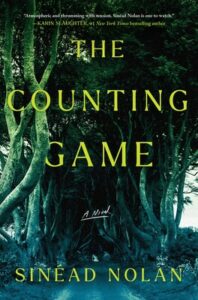
 Gallery/Scout Press
Published April 7, 2026
Reviewed by Barbara Fister
Young Jack Kellough goes into the forest that looms beside a small Irish village with his older sister Saoirse to play a variation on hide-and-seek: the Counting Game. If the one who hides isn’t found after the seeker counts to ten, it’s a test. They will never be found. That day, he can’t find his sister, and when the police are called the next day, he can’t tell them what he saw out in the woods. They call in a psychologist, Freya Hemmings, to see if she can coax something out of him.
It seems the forest is known among the locals to be a place where girls disappear. Saoirse is only the latest, and they hint that there’s a monster living there that has taken them. As Freya works patiently with traumatized Jack, she begins her own investigation into the missing, driven in part by her own tragedy, her daughter lost in a drowning. Is there a solution to be found to the mystery, or is the forest truly haunted?
Jack’s point of view is especially compelling. He seems unusually young for a nine-year-old, though children can regress when faced with overwhelming emotion, but his drawings help Freya unpack what it is he can’t express in words. He’s grown up in a troubled household, with a father who abandoned them, an unstable mother who drowned, an older sister trying her best to parent Jack and Saoirse but resentful of the burden. It’s not a happy home. “Jack’s house feels like a heart,” he thinks. “Full of throb and thrum, of blood which runs through the arteries of staircases and hiding places… Worries and fears rush around and back, never escaping.” The Counting Game that his disturbed mother taught them is similar. “If they never reached ten, it could never end. They kept going in circles. Trapped forever in the game.”
The Counting Game is full of beautiful imagery, as spooky and atmospheric as the woods, and the relationship between Jack and Freya, as she coaxes him out of his silence, is the heart of the book. It’s not perfect: The pacing drags a bit in the middle and the resolution to the case suffers from implausibility, but overall this debut suggests Sinéad Nolan is a promising talent for fans of psychological suspense.