
William Morrow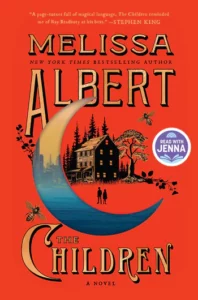
Published June 2, 2026
Reviewed by Barbara Fister
Guinevere and Ennis are enchanted children. Well, in the books their mother writes they are. I reality they live in a remote place, home schooled but without any adult instruction, neglected by their mother who demands isolation for her writing and a father who is charming but feckless. Left to themselves, they roam the forests around the wooden house that’s full of strange carvings, acquiring scars and scrapes, bound together by their rural isolation as their mother’s books, a fantasy series, becomes a bestselling phenomenon, their fictionalized selves celebrities. Though they host loud house parties, their father’s acting career withers and the marriage sours. It all ends abruptly when Guin is eleven years old. There’s a mysterious fire, and all of the adults perish in the fire-engulfed house while the children escape into the woods. The final book in the fantasy series is lost, too, as well as Guin and Ennis’s close relationship.
The story is in two interwoven time frames, the children’s childhood and their estranged adulthood. Guin has drifted, unmoored and unsure of herself, unable to find her evasive sibling who has rejected his mother’s fame and become a celebrated creator of immersive installations, always disappearing whenever she gets close. She becomes a public spokeswoman for her mother’s still-popular books, her name on a ghostwritten memoir that glosses over the reality of a childhood marked by neglect, hunger, and danger while her parents argued and threw boozy parties.
But Guin’s false front is starting to crack. As she goes on a demanding book tour to sell a memoir she didn’t write she finds her mask slipping, especially when she learns her brother has a new installation about to open. It’s called Mother, and she knows it will change the way people understand how different their lives were from the Guin and Ennis of the books. Readers think they know her and envy her magical life, echoed in the false memoir, but in reality “there was always some lack or ache or unappeased appetite, and it all held her in a perpetual state of noticing… Need pinned her so neatly inside her skin, made her live hour to hour like an animal. She was underfed and isolated; she was envied and dreamed about.” It’s a state that can only be resolved by a rupture between fantasy and reality – or total surrender to the fantasy.
This is a strange, compelling, and often astonishingly poetic story that peers behind the glossiness of fame and the innocence of fairy tales to show something darker, examining the power of the imagination to take us to unexpected places, and the ways that popular parasocial relationships with books can become a mass desire to enter a fantasy world. The ending is truly surprising, and much is left unresolved, drawing on potent hints scattered throughout, like the eerie and evocative carvings that a woman once created throughout the house, a house that seems in some ways possessed, and possessive.
It’s a story that is likely to possess anyone who reads it, leaving behind lots to think about and a weird, tingling sense of the uncanny slipping out between the pages.