
 Soho
Soho
Published July 7, 2026
Reviewed by Mary-Jane Oltarzewski
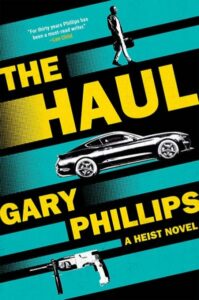
The Haul by Gary Philips is a basic, workmanlike example of an old-school heist novel: the kind of story that’s worth telling, if it’s told well. It does have the potential. O’Conner, sometimes known as OC, is a graying, semi-retired master thief, living a quiet, prosperous life in the suburbs of LA, just a few miles but a world away from the tough streets where he grew up. He’s invested the majority of his ill-gotten gains in legitimate businesses – except, of course, for the cash hidden in various stashes around the country, just in case his past catches up with him, and he has to blow town in a hurry.
Like most heist stories, this one is structured in three acts: the set-up, the execution of the crime, and the aftermath. It’s a neat, practical framework, useful for presenting the thief as “a workman … doing the work to the best of his ability,” to quote one of Phillips’s acknowledged influences, the incomparable crime writer Donald E. Westlake. Phillips weakens this framework, however, by interspersing it with flashbacks to his hardscrabble youth, spent in a group home. Some of the flashbacks introduce background, including characters who are important to the current-day plot, but some of the characters, notably OC’s surrogate parent figures – his beloved Gram Gram, the savvy, hardworking Mrs. Cho, and the mysterious Dr. Roman Apgar, director of the group home – merely convey a sentimentality that dilutes the hard-driving plot. Equally distracting, and equally unnecessary, are little Easter eggs that seem intended to quiz the reader’s own cultural memory: are you old enough to remember when libraries had card catalogs? When Goldfinger plotted to break into Fort Knox? When Game Boys became popular? If you don’t, the narration seems to ask, and if you can’t rely on them to suss out the undated time frame, do you deserve to hear this story?
The second act involves recruiting the accomplices and planning the crime: in this case a scheme to rob the sumptuously appointed “survival shelter” that billionaire robber baron Palmer Van Noy has built under his brand-new football stadium, to fortify himself and his family against “the collapse of society.” Van Noy cheated a former employee out of the proceeds of a highly profitable software application, and she wants to exact revenge by robbing the shelter, which is stocked with the massive amounts of cash, provisions, and luxuries deemed necessary to survive the apocalypse, with generational wealth still intact. This is probably the best-executed, most clearly focused section. The accomplices, however, with one notable exception – a magician/hypnotist/performance artist, whose specialty is creating diversions that allow the thieves to operate without being noticed – are a bit disappointing: unremarkable, thinly drawn, and hard to distinguish from one another. They’re good at what they do, though; the break-in is successful and extremely lucrative. A clever idea is at play here: the way that criminals and businessmen at all levels of society strive to hoard material wealth in preparation for tough times. OC has been doing this all his life, as has Van Noy, and so has another violent criminal from the old neighborhood, who has learned about the successful heist, and seeks to rob the robbers by any means necessary.
This leads to a violent, bloody, and undeniably exciting third act. The trouble is, Phillips can’t seem to decide how he wants it to end. There’s an end point that would be logical, if it didn’t conflict with the better, more tautly written summary of events described in the aptly titled “CHAPTER ONE – The End,” which appears as the novel’s prologue. That’s followed by an overly obvious explanation of why O’Conner was drawn to this “one last score,” as well as a brief but overdue examination of the previously neglected relationship between O’Conner and his longtime companion, Gwen, an affluently brought up white woman with a soft spot for the tough-talking African-American felon. It’s not that any of this is uninteresting; it’s just more than the 3-part structure can sustain. Multiple stories are being told here, and the pieces don’t fit together as tightly as they do, in the best examples of this genre.