
 Thomas and Mercer
Published June 24, 2025
Reviewed by Barbara Fister
Jenny Jones is thrilled to return to the edge of the Big Cyprus swamp with her father, a summer tradition. She’s about to turn eleven, and that’s the age when she will join the women in her lineage by being granted the gift of second sight, as her beloved grandmother Dehlia has explained. She’s also happy to be at their vacation home because she’ll be able to play with her friends, twins Tia and Mandy. She doesn’t have any friends back in town. All the kids think she’s a witch and a weirdo who killed her mother during childbirth. Having friends, even for just a few weeks, means a lot. But a shadow falls over her summer plans when a helicopter flies overhead. It must be looking for Francie Farrow, whose abduction was on the news.
We learn all about that abduction in Episode One of a true crime television drama dramatizing the crime two decades later. Alternating between episodes of the television series and the current time, narrated in Jenny’s letters to her father, the story slowly unfolds. As an adult, Jenny is being stalked and harassed by Francie’s mother Beverly, who became unhinged by her daughter’s unsolved abduction. Her fraying sanity has been shredded by the popular television drama. She’s convinced Jenny can lead her to the missing girl’s body, given her father is the prime suspect in the abduction and is currently serving a prison sentence for another violent offense.
Jenny understands why Beverly is so distraught and doesn’t want to involve the police, against the advice of her friend Arlen. She’s traumatized herself, and has never really come to terms with her kind and caring father being revealed as a monster. She hesitates to become too close to Arlen because the taint of her father’s crime, publicized by the show, has led to her housecleaning business collapsing. She doesn’t want his career poisoned, too. She impulsively decides to move back to the edge of the swamp to live with her aging grandmother to await the final episode, when she will learn for sure if her father was guilty.
Weaving between the two timelines, we learn more about Jenny’s friends, Tia and Mandy, and their new, slightly older neighbor Norah. She’s a strange girl, uninterested in going outdoors, manipulative and moody, but Jenny and the twins are starved for friendship and do what they can to bring her into their fold. It’s only later that Jenny learns what readers already know: Norah was sleeping over in Francie’s bedroom the night she was abducted. It is her testimony that led police to suspect Jenny’s father.
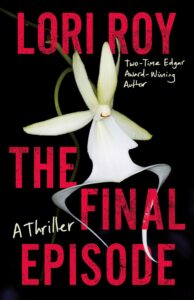
Thrillers that develop characters with deliberation, doling out surprises carefully, are often called “slow burns.” That’s not quite the right metaphor for this novel. It’s more of a gathering thickness in the atmosphere, a heaviness that threatens to pull the characters in, like the treacherous swamp where Jenny hopes to find the elusive ghost orchid on her birthday. As the momentous day approaches she decides to set her sights on a more important quest. She wants to mark her eleventh year by finding Francie. But it’s increasingly hard to sneak away and launch her search as Norah draws them into her orbit and the messy world of adults intrudes. Years later, the legacy of those days continues to pull Jenny into darkness as she awaits whatever the final episode will reveal.
The dramatic countdown to the final episode propels the story along, though the conceit of telling much of the story as episodes in a true crime series isn’t fully exploited. The potential for the dramatic version to get things wrong isn’t entertained; we are to assume it’s the true and complete story, and the producers have uncovered the truth that eluded everyone else. Likewise, the letters Jenny writes to her father only occasionally appear to be letters rather than straightforward first person narration. What actually happened to Francie is likely to be more obvious to readers than to the investigating officers or any of the family members involved, who seem to have missed asking some important questions. The ending, too, resolves things in a way that is not entirely satisfying.
All that said, it’s a deeply absorbing novel, delving into childhood relationships with the complexity reminiscent of some of Laura Lippman’s stand alone novels, creating a world that is almost suffocating in its marshy, claustrophobic intensity.