
 Hard Case Crime
Published April 15, 2025 (reissue)
Reviewed by Mary-Jane Oltarzewski
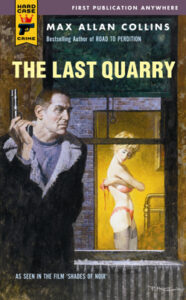
The Last Quarry, contrary to its title, is not the last of Max Allan Collins’s novels narrated by Quarry, the Vietnam veteran and hitman-for hire who’s so no-nonsense and hardboiled, he doesn’t even bother with a first name; it’s a re-release of a book originally published in 2006, featuring some brilliant midcentury-style cover art by Robert McGinniss. In the early aughties, Quarry is trying to leave his violent past behind, and lead a quiet life managing a lakeside resort on Sylvan Lake, somewhere in Minnesota, “only it’s not called Sylvan Lake and maybe it’s not Minnesota, either.” After a few decades in the contract killer business, he doesn’t like to divulge a lot of details about his private life. Quarry, in fact, is probably not his real name, but it’s how we come to know him.
Of course, the tale of a guy leading a quiet life, running a rural lakeside resort is hardly the basis for a pulpy crime novel, so it’s no surprise that trouble finds Quarry early on. During a late-night run to the local convenience store he recognizes Henry and Louis, a couple of goons from the old days: “Mob muscle who worked as a pair.” Based on the provisions Harry’s buying (“cookies and chips and Tampax,”) Quarry correctly surmises that these goons, still in the same line of work, have kidnapped a young woman and are holding her for ransom. He also knows, from his previous experience with them, that they are likely planning to take the ransom money and murder the hostage – a spoiled 19-year-old heiress named Julie Green – rather than leave any loose ends to trip over.
Quarry, for reasons more pragmatic than heroic, sees no reason to kill Julie. He has nothing against her, whereas he’s had a beef with Harry and Louis ever since they beat him up years ago, for stepping in to clean up the mess they made of an earlier job. He eliminates the kidnappers and rescues Julie, arranging to collect the cash from her father, Jonah Green – a wealthy, ruthless, obnoxious media magnate – in exchange for her safe return. The sexy, foulmouthed, equally obnoxious daughter tries to seduce Quarry, less out of gratitude than a desire to irritate her father by sleeping with the help.
This is where Quarry starts showing his age, both as a character and a literary trope. In 2006, he is still the kind of guy who goes on and on about the tits and nipples and nipple rings and hairy bush of a woman he doesn’t like very much, in a display of tough-talking manliness or maybe rebellion against the “politically correct” culture of the current century. A character like Quarry is not supposed to be sympathetic or even likable, but none of this really advances the story, or tells the reader anything they don’t already know about him. But there are, indeed, still a few things worth finding out about Quarry, the heiress, and her family.
These become increasingly apparent when Jonah contacts our anti-hero a month or so later, seeking to hire him for a hit on a very different sort of woman. Janet Wright is a pretty, pleasant, soft-spoken librarian, who appears to be guilty of nothing more than dating a possessive, abusive creep from a prominent local family. Quarry accepts the job and begins to surveil the target, unable for the life of him to figure out why Jonah wants her dead. The fact that he is the least bit curious about the librarian’s fate indicates a change in Quarry’s character, even more so than the glimmer of sympathy that leads him to intervene on Janet’s behalf and scare off the abusive boyfriend. He tries to persuade himself that the latter is an inconvenience, an impediment to the job at hand, but the signs are there. Quarry has not gone soft, by any means, but he’s evolving. When a final twist reveals the connection between Janet Wright and the Green media empire, it also reveals the title character’s true willingness to retire, not just as a hitman but as a tired stereotype of rugged masculinity.