
 Mulholland
Published July 29, 2025
Reviewed by Barbara Fister
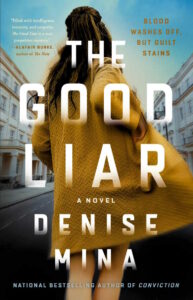
As this short, tense novel opens, Claudia Atkins O’Sheil is preparing to blow up her life. In twenty minutes she’s due to give a speech about her most famous case as a forensic scientist. But it’s not the speech her host and mentor, Sir Philip Ardmore, expects her to give. Rather than celebrate the way her ground-breaking system for analyzing blood spatter evidence solved the infamous Chester Terrace murders, she’s planning to explain how it got the case wrong. This will not only destroy her reputation and Sir Philip’s, it will call into question scores of convictions and will anger some very powerful people. She has to get the truth out in a way that people will find convincing, and she has to do it before she is stopped.
Flashback to a year earlier, to a gathering just a few months after her husband’s death in a car crash. As she’s fending off Kirsty Parry, an awkward upper-class acquaintance of her husband who is desperately looking for work in Claudia’s field, Sir Philip gets a phone call that unmoors him. He’s so rattled she agrees to drive him to the scene of a gruesome crime. Two people have been murdered in a Regent’s Park neighborhood on a street where the houses are worth tens of millions, many of them empty investment properties owned by secretive shell companies. Someone entered the house, killed their guard dog with a shotgun, and then attacked both occupants with a knife. The blood spatter is voluminous and even without running it through her software program, Claudia can read it like a book.
It falls to Sir Phil to identify the bodies, since the home belongs to a friend from school days. He worries the killer may have been the dead man’s son, the privileged party boy and addict Viscount William Stewart, who stands to inherit a title and properties that amount to half of Scotland. He was on bad terms with his father, and when he stumbles up to the house, he’s taken away by the police for an interview. Claudia finds the situation strange; they fail to caution him before questioning him, and she urges him to ask for a lawyer. She soon realizes he is the sole focus of the murder investigation, though it doesn’t make sense to her. Whoever killed his father and fiancee would be drenched in blood, and he is not.
Meanwhile, she has plenty to deal with. She’s having trouble connecting with her two teenage sons who, like her, are dealing with their father’s sudden death. Though she misses her husband fiercely, he had been prickly and paranoid, and she suspects his accident was actually a suicide. Her sister Gina, who is staying with them, is both beloved and bothersome, an addict who can’t seem to stay sober however much she tries.
Professionally, things are looking up. She and her sister grew up poor in Glasgow; while Gina clings to her working class identity, Claudia finds herself susceptible to the allure of entering the upper class through the generous perks of her job. But there’s something off about the Chester Terrace prosecution, and when Kirsty Perry raises a concern about the algorithm behind Claudia’s blood-spatter analysis tool, she faces a dilemma.
The Good Liar deals with some of Mina’s common themes. She has a soft spot for broken people like Gina and the drug-addled prime suspect. A lawyer who ultimately defends him is a wildly inappropriate and clever man who has a tainted reputation, though Claudia loves his zaniness and recognizes his underlying moral fiber. One of her sons is always in trouble, and she loves him for it even if she feels unable to cope. Faced with a choice between a comfortable life and the risk of raising unwelcome questions, she struggles to decide the best course.
We witness this struggle in the opening pages and in passages that, in intermittent sections, fill in those twenty minutes until she gives a speech that will destroy her life if she tells the truth. Mina provides insightful and sometimes quite funny observations about wealth and privilege (one character describes shell companies as “little golems made of capital”) and gives us a visceral feel for Claudia’s conflicting urges, while sketching out a society in which power comes from hoarding money and maintaining an elaborate structure of secrets and lies. While uncovering what really happened at Chester Terrace drives the plot, the tension comes from wondering what Claudia will choose to say when she steps up to the podium to give her speech.