
 Simon & Schuster
Published July 8, 2025
Reviewed by Barbara Fister
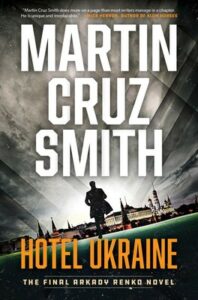
For those who have followed the career of Arkady Renko since he first appeared in 1981’s Gorky Park, there’s dispiriting news below the title: This is the final Renko novel. There’s no doubt the Russian investigator deserves a quiet retirement; he’s been investigating crimes for over forty years, through the end of the Soviet era, into the unsettled period of the looting of public resources by new-made oligarchs, and into Putin’s iron-fisted regime. Moreover, he’s been diagnosed, like the author, with Parkinson’s disease. But readers will be reluctant to let him go. He’s one of the most intriguing and complex of crime fiction’s heroes, and a thoroughly Russian guide, however ambivalent, to his country through decades of upheaval. He may be retiring, but he’s not slowing down, even if it means following leads into Ukraine in the early months of Putin’s brutal invasion.
The story opens with a demonstration in a Moscow square, where protesters chant “no to war.” Arkady goes there to find his adopted son Zhenya, who is quickly snatched up by the police, charged with using illegal language. Renko is able to get him off with a warning, but if he’s caught using a forbidden word again he could be jailed for five years. While this criminalization of the word “war” has been in the news, the absurdity feels fresh and sinister.
Soon after, Renko’s boss saddles him with a politically sensitive murder: a deputy minister of defense has been beaten and slashed to death, apparently by two people wielding different weapons, at the luxurious Hotel Ukraine, a Soviet-era monument now decorated with pseudo-socialist modern art “to give foreigners a false sense of history and locals a false sense of comfort and nostalgia.” He is joined by a former flame who works for the FSB who quickly takes over the case. She arrests a Ukrainian diplomat who is obviously innocent, while Renko follows a lead to a man who leads a powerful mercenary force called the 1812 Group (a fictional version of Yevgeny Prigozhin’s Wagner Group). With information from Zhenya’s open source internet research he traces clues to the heart of the war with journalist Tatiana Petrovna, bearing witness to the atrocities in Bucha and catching a glimpse of his adversary.
While it’s sad to say goodbye to Arkady Renko and his thoughtful, ironic, and often rebellious take on his country, we are lucky to have journeyed with him this far. You can gain a certain amount of understanding by following news reports and from experts, but there’s a different kind of knowledge gained by spending over four decades in the company of a fictional character who provides a more sensory, intimate picture of a place we may never visit but which looms so large in global affairs.