
 Grove Atlantic
Published July 8, 2025
Reviewed by Barbara Fister
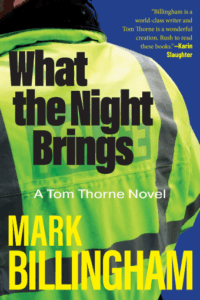
Tom Thorne has had a long career as a detective. First encountered in Sleepyhead (20o1), he has appeared in nineteen books. Here, he’s dealing with a case that’s a ticking time bomb: Someone has kindly left a box of four doughnuts for a group of uniformed coppers assisting at an arrest. They’re pleased by the gesture. Not everyone appreciates their hard work these days – but it soon becomes clear that that includes whoever brought the treats. By nightfall three of the coppers are dead from poisoning and the fourth is barely hanging on. That’s just the first attack against officers from someone unknown who has a grudge and a violent streak. They have to find the vigilante, and fast.
There’s a complication, though: apart from the first victims, the targeted cops are not London’s finest. They’ve all engaged in violence against women, and have gotten away with it, protected by corruption in senior leadership. Whoever has decided to right the scales of justice has inside information and is actively seeking to punish members of the force who violate The Police Officers Oath of Attestation (which serves as the book’s epigraph). Thorne and his band of close allies, a varied and distinctive group of characters who have developed over the course of the series, have to find out who is behind the killings while realizing they can’t trust anyone inside the force.
This long and densely-plotted novel hangs on a gripping hook and unfolds with a series of twists and surprises, though there’s time enough to give the characters plenty of space to develop and a meaty enough conflict to add color and complexity to the story. There’s also a wrinkle that takes the familiar issue of the thin blue line protecting their own to a much creepier, nastier level. And while readers are used to a shocking reveal at the end of a thriller, this one is truly a shock, but not because the bad guy is revealed; it’s more original than that.
There is a long tradition of police procedurals including rogue officers or annoying bosses who are corrupt or incompetent, but it’s a genre that generally celebrates the mission of policing, the comradery of a team, and the moral fiber and bravery of its protagonists to the point it sometimes becomes “copaganda.” Thorne is a moral character who is tough, as one expects of cop heroes, but is also able to question how police power lends itself to abuse. The small team has bonds of shared danger, a sense of purpose, and a lot of humorous banter to leaven the story, but the system itself, and the goals of officers in it, are put on the stand in a way that is unusual. The corruption depicted here is so ingrained, so fundamental, it’s not something that will be tidily resolved by the good guys and set right in the end.
Billingham does an admirable job of continuing a popular series while raising questions about its very foundations, using his trademark mixture of character chemistry, tension, and humor to burrow into what it is that makes us like the procedural and how it can become more open to the complex reality of police culture, raising questions about how its power over the populace is deployed in a world where citizens increasingly ask those questions themselves.