
 Mulholland
Published September 16, 2025
Reviewed by Mary-Jane Oltarzewski
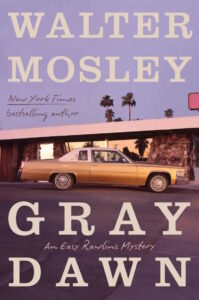
Each of the novels in Walter Mosley’s Easy Rawlins series, going back to 1990’s Devil in a Blue Dress, stands alone as a compelling murder mystery, populated by a colorful (pun intended) cast of characters. Taken together, however, they are, as Mosley says, “kind of like a twentieth-century memoir, a fast-paced unspooling of events that came from a people … that had been fighting for liberation and equality longer than any living soul could remember,” who have “worked hard, suffered terribly, and despite all that, made this country a shining example, a beacon of freedom in the face of freedom denied.” This description, while absolutely accurate, overlooks an important aspect of the “memoir” : the development and maturation of Ezekiel Rawlins, from an embittered loner stalking the dark streets of post-war L.A. , to a man deeply committed to protecting his own family, and other families as well.
The Rawlins of Gray Dawn and its predecessor, Farewell, Amethystine is as concerned with love as he is with crime: love for his adopted children and grandchild, and for the beautiful, dangerous Amethystine Stoller, who bade Easy farewell in the earlier novel, but couldn’t stay away for long. She returns early on, followed shortly by another unforgettable woman from his past. These are, he explains, “The two most important loves in my life, each one more than I could manage.” Both are the kind of women whom readers of noir fiction dream about, who leave passion, drama, heartbreak and death in their wake: the kind of women Easy Rawlins can’t stay away from.
The plot begins with a relatively straightforward missing persons’ job. A rough-looking man named Santangelo Burris – a “shitkicker out of deep Texas” – hires Easy to locate his missing aunt, purportedly to deliver a message from her elderly mother. The truth, as it turns out, is considerably more complicated, and more dangerous. Searching for Santangelo’s aunt, Easy happens upon the scene of a domestic massacre: a family has been murdered, and the sole survivor is a tiny girl who hid from the killers, and won’t stop screaming or clinging to Rawlins. Her instant, desperate attachment to him is not enough to keep the LAPD from considering him a suspect, until his connections in the department vouch for him, less out of respect than in recognition of his value to the investigation. Things get more complex from there, but the convoluted plot is less important than the people whom it pulls into Easy’s orbit: lovers, ex-lovers, relatives and neighbors heretofore known and unknown. There are people, and animals, who can be simultaneously affectionate, loyal, and brutally vicious. All of them are in mortal danger, and all are working hard to protect one another. Together, they illustrate the expansive dynamics of Easy’s life, and of the human condition as a whole.
This rich panorama of humanity ends, in almost Shakespearian fashion, with families reunited, an act of vengeance, and of course, a wedding. It’s no spoiler to say that Easy, the passionate but perennial bachelor, is not the one who gets married; but the story does end more with thoughts of love, than of revenge.