
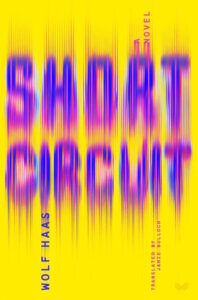
 Translated by Jamie Bullock
Harper Via
Published April 21, 2026
Reviewed by Barbara Fister
A man named Franz Escher who collects jigsaw puzzles is waiting for an electrician to come to his apartment to fix a loose power outlet. Bored, he picks up a novel to pass the time, one about Elio Russo, who has helped the authorities in Italy build a case against powerful mafia figures and is now in prison, awaiting release and a new life in witness protection. In the novel Elio, too, has a loose electrical connection. To pass the time, he reads a novel about a man who is waiting for an electrician. And so the story, or pair of stories, begin, like an Escher drawing, circling around themselves endlessly – though unlike the drawings, the stories do work their way to a conclusion as the stories eventually converge and resolve.
In the beginning, Elio and Franz’s stories seem not only separate but not even loosely connected except through the books they pick up. But things happen that eventually begin to merge: Franz accidentally electrocutes the electrician, Elio establishes a new life in Germany, where he restores a Vespa, leading to another encounter with mafia figures. Franz, who works in the funeral business, meets the electrician’s widow; Elio has a family, starts a bicycle shop, and is unnerved when his daughter begins looking into his past as part of a family tree school assignment. Though they start out separate, their stories become entwined.
What starts out as a humorous yet somewhat arid metafiction, with characters who are barely sketched in, grows increasingly warm, human, and engaging. It feels as if the books the two main characters are reading are coming to life, animating the shared story. There remains something a little cartoonish about it all, with some imaginative special effects to bring the short book to a happy ending. But maybe it’s not really an ending; as soon as the final puzzle piece is found and placed where it belongs, Franz begins to wait, again, for the electrician.
Readers who are willing to play along from the start will enjoy the acceleration of the stories as they entwine, never totally losing the strangeness of the Escher-inspired circularity.