
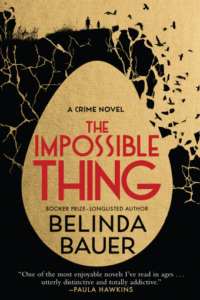
 Grove Atlantic
Published April 8, 2025
Reviewed by Barbara Fister
The thing in question is an egg: a rare, bright red guillemot egg coveted by rich men who greedily collect eggs in the early twentieth century. They want it so they can possess something their wealthy competitors don’t have.
A small girl, raised in poverty and neglected by her family, has discovered the egg. The land she lives on in Yorkshire overlooks the sea, where sheer cliffs are home to countless nesting seabirds. Men have been harvesting eggs from the cliffs to sell to collectors, but there’s an overhang in this area that has made it impossible, until a very small child could slip through a narrow crevice to be lowered down on a rope to try her luck. It would be a fine thing to have some eggs to eat – but the egg she brings up turns out to be worth more than she can imagine.
In the present time the egg has turned up, contained in an ornamental wooden case, in a cluttered attic belonging to “Weird Nick,” best friend of Patrick Fort (first encountered in 2016’s Rubbernecker). Patrick finds his friend tied up along with Nick’s mother after an eBay listing drew thieves to his house to steal the egg. Suspecting there’s something special about the egg, Patrick and Nick set out to recover it and, in the ensuing events, have some hair-raising adventures.
The characters in this novel are so well developed it’s not difficult to keep up with the two story lines. The only problem is they are each so engrossing it’s hard to leave one of them when it’s time to learn more about the other.
Those who have read Rubbernecker are likely to remember Patrick warmly. He has trouble parsing people’s idiomatic expressions and unreadable emotions. Seeing the world from his perspective highlights the strangeness of everyday interactions. The small girl and the people around her also give us an unusual perspective, one shaped by poverty and isolation in a place of beauty and risk. We even get the perspective of the pair of guillemots whose unusual eggs have made them too valuable to be left alone to hatch. Year after year, their chance to raise chicks is forfeited to human greed. It’s a rare treat to have even animal perspectives so beautifully and sensitively represented.
Sometimes a mystery surprises us because it immerses us in an unfamiliar subject – say, change ringing as it is described in detail in Dorothy Sayers’ The Nine Tailors. The now-illegal practice of egg collecting is featured in the Vera Stanhope series, so it’s not entirely novel, but here it is explored in depth through a combination of vividly-rendered historical fiction and contemporary adventure. It’s a rollicking read, touching, funny, well-paced, and highly original.