
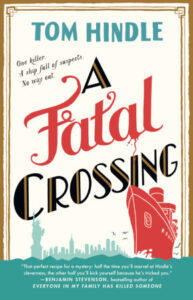
 Dutton
Published July 28, 2026
Reviewed by Meredith Frazier
Taking place in five days in November of 1924, A Fatal Crossing by Tom Hindle harks back in many ways to Golden Age mysteries. It’s set onboard the Endeavour as she sails from England to New York, and when a man is found dead at the foot of a staircase, the scene is set for a “closed room” sort of mystery. At first, it seems the death might be accidental, and the soon-to-retire ship’s captain wants that to be the case. However, James Temple, a Scotland Yard detective who happens to be onboard thinks differently. Paired with ship’s officer Timothy Birch who is tasked with being sure Temple doesn’t disturb the passengers, Temple begins an investigation that leads to stolen paintings, dodgy art-world dealings, possible organized crime connections, and, of course, more murders.
While that may sound complicated and convoluted, Hindle leads the reader through the tangle with ease, keeping all of the characters and plot twists clearly distinguishable and fun to follow as the suspect list grows and red herrings abound. Hindle also plays fair enough that some of the outcomes might be guessed at, but many are likely to come as a surprise.
While Temple and Birch feel under pressure to solve the crimes in the four days before the ship reaches New York, since docking will give the perpetrator the ability to escape undetected, the pace is steady without being frantic. That allows the story to unfold with nicely held tension, but it isn’t a page-turner. (That said, the short chapters do make it easy to make speedy progress.) Hindle also does a nice job of sketching the setting in order to capture a sense of the era, but the emphasis here isn’t on the historical elements. The emphasis isn’t really on character development, either, although many of the characters have enough backstory to give them an extra bit of depth. That depth not only tends to make them interesting but also adds to the overall mystery and gives the solution a bit of heft as well as believability. Mostly, though, the interest here lies in the plotting, and Hindle does that cleverly enough to craft a story able to keep you intrigued to the end.