
 Harper Muse
Published October 6, 2026
Reviewed by Meredith Frazier
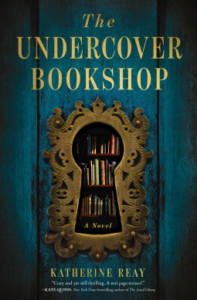
It’s the winter of 1949, and Gemma Brown has just arrived in the Oxfordshire village of Great Rollright, lured there by the promise of her own bedsit. There’s the job at the general store that goes with the bedsit, of course, that is also appealing, but it’s the room of her own that is the real enticement, along with the chance to escape post-war London and live in an idyllic village much like those she finds in the Golden Age mysteries she loves. Fitting in and making friends is harder than Gemma anticipates, though, but she does make an effort, and slowly she gathers a small group of friends, including Peggy, Charlie, and, surprisingly, the enigmatic Ursula who agrees—after a disastrous cake mishap—to teach Gemma to bake. This last friendship comes as a surprise to Gemma’s other friends because Ursula has very little interaction with the other villagers and is, therefore, the subject of much speculation. When Gemma notices a large antenna on Ursula’s roof, along with a few other unexplained things, the village gossip about Ursula’s husband being a Soviet spy begins to make sense, and Gemma, Peggy, and Charlie get caught up in an investigation fueled a much by imagination and mystery-novel plots as it is by facts. Maybe. As Gemma digs deeper into Ursula’s mysterious actions, she uncovers a tale of international intrigue that will change her life forever.
Framed by a prologue and epilogue set in 1991, Gemma’s story is set up right from the start to detail a moment in the life of “the Soviet Union’s most famous and most celebrated spy, Ursula Kuczynski.” Ursula is real. Gemma and her encounter with the Soviet spy are pure fiction. But the interest in The Undercover Bookshop lies in the unfolding of Ursula and Gemma’s relationship and Gemma’s investigation into and discovery of who Ursula really is, and it plays out in a well-paced (but not fast-paced) novel. The novel is also, most of all, about a community of people trying to find their way forward after World War II, trying to figure out who they are and want to be and what they want their country to be. While the threat of the Red Menace underlies the relationships and creates tension, the novel is much more character driven than plot driven, and it’s the character development that’s really at the center of the story. In fact, in the epilogue, much is hinted at but left mostly unsaid about events of the intervening 40 years that, had they been detailed, would have made this a much different book. But Katherine Reay has chosen to focus on the characters as people in an evolving world, and the result is gentler than might be expected in a spy novel. Reay’s research into both Ursula and Golden Age mysteries is evident in her creation of setting, characters, and fictional events, all of which come off as entirely believable. And while this may be more of a “howdunnit” than a “whodunnit,” there are still plenty of surprises along the way, as well as a bit of romance.