
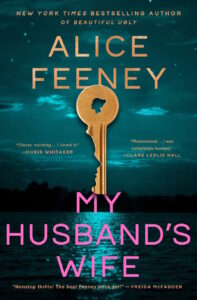
 Flatiron Books, Pine & Cedar
Published January 20, 2026 (hardcover), January 19, 2027 (trade paperback)
Reviewed by Sharon Mensing
If you like twisty, disorienting thrillers, you will love this one. It had some aspects that I really liked, others I didn’t, but ultimately it kept me interested and engaged.
There are alternating short chapters, moving from one character’s perspective to another’s and from timeframe to timeframe. The first two chapters introduce two characters who are seemingly unrelated, although it’s obvious from the get-go that Feeney plans to bring it all together in the end. These two highly disparate perspectives and characters create an unsettling, off-balance atmosphere that continues throughout the book. The only thing that is not confusing about the tone this sets is that it quickly becomes clear that people are not who they seem to be. As the book continues and the ground seems to shift underneath the characters and the reader, this becomes either fascinating or annoying depending upon the reader’s predilection. Because the true nature of the characters changes so frequently, the characters are never fully developed. Although we are allowed inside the heads of the various players, the book is ultimately plot driven…not character driven.
Feeney does a beautiful job with the descriptions of a small seaside Cornwall village and the house (Spyglass) where much of the action takes place. Themes of revenge, how far parents will go to keep their children safe, infidelity, and what might happen both personally and sociologically if we knew the dates of our deaths play out during a very fast-paced complex plot. The last (pre-knowledge of our deathday) brought to mind Nikki Erlick’s The Measure, although I found Feeney’s take more compelling.
There is a great deal of foreshadowing in the book, some of it repetitive so the reader won’t really miss it. But the twists come so fast and furiously that there isn’t necessarily time and space to ponder the hints. While in the midst of the book, I several times found myself saying “Wait…what?” and having to double check who was speaking. Because of this, I felt as though I should have been keeping a sort of organizational chart of the characters. Feeney is very clever with these changes of perspectives, and I am normally quite a fan of disorientation in a book, but this one definitely brought me to the brink of an acceptable level of confusion.
In the end, the resolution pulls all the pieces together in a satisfying manner. However, to do so, Feeney relies on one character explaining it all to another. As well as it works, this is not my favorite means of closure. By the time we reach that point, though, many readers will just want it all explained! This was one of the most disorienting books I’ve ever read, and as we reflect with the characters on the underlying themes, it provided a lot of food for thought.