
 Little, Brown
Published October 20, 2026
Reviewed by Mary-Jane Oltarzewski
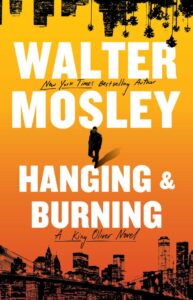
Walter Mosley’s Hanging and Burning is a tightly wound, bicoastal noir that takes private detective Joe “King” Oliver back and forth between Los Angeles, and his home turf in Brooklyn and the surrounding boroughs of New York City. More baroque than Mosley’s Easy Rawlins stories, it features a plot that is somewhere between grand opera and a telenovela with a jazzy soundtrack, full of murders, near-murders, and families hidden, broken, and reunited over the course of several decades. It all begins with a favor to the matriarch of King’s own family, the gravely ill, but possibly indestructible Grandma Brenda. “Grandma B” is being treated at a state-of-the-art medical facility in LA for a rare form of cancer, receiving the kind of care a person can afford when her “boyfriend” (both partners are over the age of 90) is one the richest men in the world. She has befriended a fellow patient named Arman Babylon, an old gangster who keeps, in his bedside table at the hospital, a loaded gun and a framed photo of a pretty young woman. The woman, he says, is his estranged granddaughter Twyla, and he wants to locate her before he dies. Grandma assures Arman that her grandson is just the man for the job, and no one who loves Brenda can refuse her a favor.
It quickly becomes clear that this is far more than a simple missing persons case. Before he can locate Twyla, King needs to identify her birth mother, and figure out how both women are connected to a number of brutal crimes on both coasts, going back nearly forty years. Fortunately, he has financial resources provided by Grandma’s billionaire companion, and backup in the form of a small private army headed by security expert Melquarth Frost, “a recovering crazed killer who lived in a deconsecrated church” somewhere in Staten Island, NY. Frost could headline a whole series of thrillers on his own, but here it’s enough to know that he and his life partner, another fearless mercenary named Oliya Ruez, are ready to watch King’s back at a moment’s notice, and that both embody the observation that “Anything can be a weapon: a camera, a word, a night of passion, a secret either told or kept, even an unknown gunman hidden behind a wall.” All of these weapons are put to good use, most of them more than once, in King’s effort to find Twyla, and figure out why she went missing.
Although the story is told from the viewpoint of King, a 50-something ex-cop from Brooklyn, who was himself convicted of a brutal crime and incarcerated for several years before being exonerated, the female characters are all strong and interesting, representing a wide variety of ages and backgrounds. King has the sense to know that the staff and residents of an elder care facility, the manager of a blues club, a local LA librarian, and the organist at a church called “The Ministry of the Divine Orgasm” are all as likely to possess sharp insights and valuable information, as anyone in law enforcement. He gains the confidence of a gifted little-known jazz musician, who has bluntly advised him “‘I don’t need no smoke up this ass, Mr. Oliver,’” by telling her “‘You know you can trust me cause you haven’t shot me yet,’” thinking to himself that “we might end up being friends, if we didn’t die trying.” It’s this kind of hard-boiled open-mindedness that enables King Oliver to protect and sustain the relationships, and the people, who assist him on his search for Twyla, and to understand why that search is so important to his wise, beloved grandmother.