 Summer is always a good time for reading, and we had plenty to keep us busy in June, from action to cozies to historicals and beyond. There are many more books to look forward to for summer reading: In July, we’ll be reviewing new books by Martin Cruz Smith, Stacey Abrams, Denise Mina and many more. See if there’s something here that makes you want to sit in a rocking chair with a good book.
A. J. Landau, Cold Burn – “The action is fast and furious, in short chapters, moving quickly from one location and event to another. The reader is often put on hold as the action flips between characters, but it cycles back around so quickly that we don’t lose interest but rather read on to find out what happened next. The end result is a book that is hard to put down.” (Sharon Mensing)
Craig Johnson, Return to Sender – “The book is filled with bizarre and kooky characters, including a dangerous cult with a focus on UFOs, the ex-hippie postal worker, a frequently drunk and combative biker, a group of elderly followers of the cult, and many more… Johnson writes with more humor in this book than is usual for the series, and I found myself laughing out loud at times.” (Sharon Mensing)
Mel Pennant, A Murder for Miss Hortense – “It’s interesting to see how the cozy sub-genre has recently become a gateway for diverse voices from marginalized communities that are too often perceived as places of violence, danger, and menacing foreignness… ” (Barbara Fister)
Nilima Rao, A Shipwreck in Fiji – “[The] plot threads are expertly woven together, adding in some humor, a dash of critique of British colonialism and English disparagement of their non-white subjects, a deepening of Akal’s personal background, and a fascinating cultural struggle…” (Barbara Fister)
Jess Walter, So Far Gone – “Told at a gallop, with lots of wry humor, the end result is not so much a portrait of a country riven by insoluble differences as it is about a family split by secrets and betrayals, living in a country where people are hurting and adrift, bombarded by too much information and too few connections, unable to see one another through the drifting smoke of fires set by people who don’t care about the consequences.” (Barbara Fister)
Chris Chibnall, Death at the White Hart – “It’s not cozy – this is not the sort of village you’d want to live in, and the villagers’ eccentricities are not especially heart-warming – but as a traditional mystery it has the familiar elements of a well-produced BritBox drama.” (Barbara Fister)
Laura Lippman, Murder Takes a Vacation – “The book feels like a classic mystery, unique for the characterization, but not really for the plot. It’s more fun than it is an intellectual challenge… it was a pleasure to spend some time in Mrs. Blossom’s company, and I can recommend it as a light mystery novel.” (Sharon Mensing)
Eliza Reid, Death on the Island – “It has a classic locked room feel to it, with no one character being central to the plot, but rather all being under suspicion when a murder takes place. ” (Sharon Mensing)
Mary Anna Evans, The Dark Library – “Mary Anna Evans has combined a love of old-fashioned Gothic tropes with feminist sensibilities… It’s an original celebration of the Gothic tradition, replete with a brave heroine, dark secrets, and brooding landscapes.” (Barbara Fister)
Christina Dodd, Thus With a Kiss I Die – “… the main characters are strongly portrayed and given some real depth. The mystery itself is convoluted enough to offer a nice puzzle and drive the plot, but the characters are the real stars of this novel.” (Meredith Frazier)
Lori Roy, The Final Episode – “Thrillers that develop characters with deliberation, doling out surprises carefully, are often called “slow burns.” That’s not quite the right metaphor for this novel. It’s more of a gathering thickness in the atmosphere, a heaviness that threatens to pull the characters in…” (Barbara Fister)
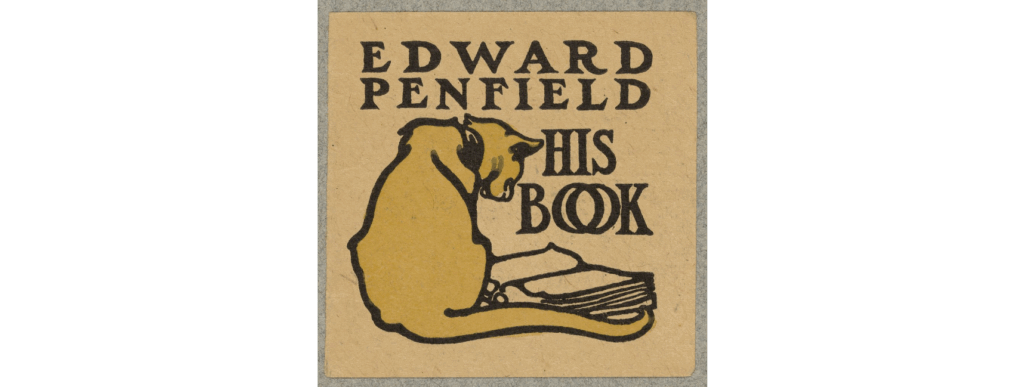
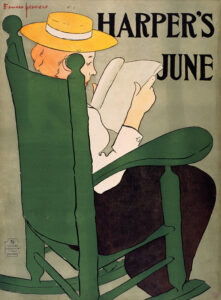
The illustration at the top of the page, by the way, is by Edward Penfield, who put a cat on his bookplate. We liked his evocation of June as a time to read on the cover of an 1896 issue of Harper’s, but we can’t resist cats, either. So here is his personal bookplate, courtesy of the Library of Congress.