
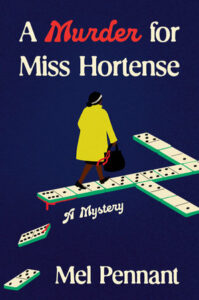
 Pantheon
Published June 10, 2025
Reviewed by Barbara Fister
Miss Hortense is trimming her Deep Secrets rose bush (planted years earlier as a reminder of something she can never forget) when her hypochondriac friend Blossom stops by to tell her Constance Brown has died. This is momentous news, because Constance has been the Pardner Lady for the past thirty years, after taking that role over from its founder, Hortense. When Blossom wonders aloud if Constance may have been murdered, Hortense dismisses it – but only to avoid her friend joining her in an investigation that might lead to danger.
A pardner is a financial arrangement among a group of trusted participants who pool their money and make loans to one another on a rotating basis – particularly useful in an era when British banks refused to serve Blacks. When Jamaicans arrived in England as part of the Windrush Generation to help with a labor shortage after World War II, they brought this informal banking and investment tradition with them. Hortense was one of the group’s original founders in 1963, using her share of the pooled finances to buy a little house, but was abruptly ostracized for reasons we only learn about later.
When Hortense was part of the pardner, members loaned funds to one another which helped them establish roots, buy homes, fund a community center, and invest in starting a funeral home after a member’s son’s body was treated disrespectfully by a white undertaker. They also began “Looking Into Bones” – investigating crimes, like the fatal beating of the funeral home owner’s son, that were not taken seriously by the police. It was the twelfth “bones” investigation that was Hortense’s undoing.
Someone was attacking women brutally. When Hortense urged a friend in the pardner to follow a speeding vehicle, they crashed, and her friend was killed. The accident not only led to Hortense’s ejection from the pardner and from her circle of friends, it laid the groundwork for another mystery. Decades later, a dying woman’s last words to her estranged daughter were “it’s bone twelve. The Pardner Lady is watching. It’s her fault.” That sets the daughter on a quest to track down the Pardner Lady and find out what it all means.
It’s interesting to see how the cozy sub-genre has recently become a gateway for diverse voices from marginalized communities that are too often perceived as places of violence, danger, and menacing foreignness. At a time when anti-immigrant sentiments drive political discourse and lead to injustices (such as the 2018 “Windrush scandal” in which Jamaicans who had lived in Britain for decades but couldn’t prove they had arrived during the Windrush rebuilding efforts were unfairly detained and deported), the small, tight-knit community setting and the not-too-violent plots so typical of the cozy mystery provide a fertile ground for sharing the domestic lives of immigrants and other marginalized populations.
A Murder for Miss Hortense immerses the reader in the Jamaican community in a Bigglesweigh, a fictional suburb of Birmingham, weaving between events of the early 1960s and the early 2000s. The characters speak in a distinctive patois and their relationships and local culture are flavored with their roots in the Caribbean and the often painful reality of living in Britain. The large cast of characters, shifting time frames, and multiple plotlines can make it difficult to put all the pieces together, but this series debut by a British playwright is a fine addition to the growing rainbow of cozy mystery series that lets readers spend time in a setting that is different than their own, yet not so different after all.