
 Viking
Published September 23, 2025
Reviewed by Meredith Frazier
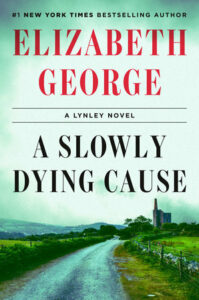
Delivering on the promise of the much-anticipated return of Elizabeth George’s signature series characters, A Slowly Dying Cause is set primarily in Cornwall and follows the investigation of the murder of a middle-aged man who has left his wife and family for a teenage dance instructor he meets on a cruise. Obviously, suspects abound. When the main suspect turns out to be Daidre Trahair’s brother, Barbara Havers and Thomas Lynley get drawn into the investigation, even though it is well off their turf.
For Havers/Lynley fans, the duo’s appearance is a long time coming in the course of events. First, there’s a great deal of story set-up to get through, including the introduction of a large cast of characters (and their sex lives). One interesting technique in this long opening section is the appearance of the murder victim as a point-of-view character. In addition to his telling of events, George alternates among several characters’ points of view throughout the novel, and each provides necessary information as well as interest-provoking confusion as the plot unfolds. Each perspective colors the truth differently, of course, and discovering where the “real” truth lies is at the heart of the solution. George’s storytelling mastery ensures that the resolution comes as a surprise, although suspicions about what happened and why may arise earlier, and the realism of the outcome may leave you feeling less than satisfied.
Overall, the plot is nicely complicated, the setting is well drawn, and the characters are fully developed, but in spite of that, the novel leaves something to be desired (admittedly, that could be because expectations are high at the thought of a new Lynley/Havers novel). Some of the characters and their actions, while interesting, don’t lend much, if anything, to the story arc. The appearance of Lynley and Havers comes much too late in the novel, they are too little involved in the investigation, and when they do finally appear, there is a vague sense of George simply going through the motions and/or relying too much on old material. However, in spite of that, once Lynley and Havers show up, everything from pacing to plot development gets better, and the last few chapters may have you reading late into the night. If you’re new to the Lynley/Havers novels, earlier ones are better introductions to the characters and their strengths. If you’re a long-time fan of the series, A Slowly Dying Cause is worth reading, but you may find that it’s not quite up to George’s usual standards—or your expectations.