
 Penzler/Mysterious Press
Published July 22, 2025
Reviewed by Mary-Jane Oltarzewski
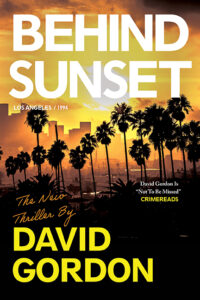
Behind Sunset is an action-packed crime novel, but most of the action takes place at the expense of its central character, who is repeatedly buffeted, battered and beaten by people and forces that are beyond his control, under circumstances that are often hilarious. Set in the last decade of the 20th century, it follows the adventures of Elliot Gross, a graduate of an elite East Coast college who had been naïve enough to think that he could move to LA and live the good life as a successful screenwriter. Instead, he’s living in a (barely) converted garage, barely making a dent in his massive student loans by writing for a well-known smut magazine called Raunchy. The magazine (this is 1994, remember, when internet porn had not yet replaced the print genre) is owned and operated by Victor Kingman, the notorious self-made multimillionaire, vulgarian libertarian and free-speech advocate, who is not averse to dabbling in blackmail. Although the Raunchy gig pays poorly, it is “by far the best-paying job that [Elliot] had ever held and the one that made the best use of the master’s in English and Comp. Literature.” Elliot has learned, unfortunately, that the wages of sin “were, as it turned out, disappointingly low.” Worse yet, his boss likes him – so much so that he rewards his young protégé with a black satin team jacket that features the magazine’s logo emblazoned in bright pink on the back, and saddles him with the plum assignment of taking home a box full of inflatable sex dolls, with orders to try them all out, rate them, and write a 2500-word review in time for the special Valentines issue. It’s little wonder that the novel begins “Pornography was making Elliot sad.”
Behind all his foul-mouthed bluster, Victor is sad, too, and weirdly romantic. Still mourning the loss of his wife, he believes he has finally met her successor: Crystal Waters, a dream girl with an angelic face and a body that’s hot as hell. Smitten, Victor dreams of making her a star: not just the centerfold of the month, but “Girl of the Decade.” The only trouble is, Crystal has vanished before Raunchy can even publish her first centerfold. Vic recruits Elliot to help find her, but first, poor Elliot has to figure out why dead bodies keep turning up, everywhere he looks.
The plot unravels in three parts: the set-up, which ends with Elliot getting fired unceremoniously from Raunchy, after he gives away the satin jacket and it turns up on the first of the dead bodies. The second part involves his next job, working for a vaguely cultish, New Age wellness empire that exploits the poor while simultaneously attracting a large community of rich and famous acolytes, connected to the film industry. In Part 2, the action doesn’t stop, but the plot becomes more convoluted as Elliot keeps stumbling (literally) across clues and coincidences connected to the disappearance of Crystal Waters, despite the fact the Vic has told him, in no uncertain terms, to stop looking for her.
The third part takes place as Elliot, having discovered Crystal’s whereabouts and her true identity, has to rush home to Queens NY, to deal with a family emergency. By now, he realizes that his search for the elusive dream girl is somehow connected to his own past, and learns that nobody’s past, not even his own, is quite what it has appeared to be. His parents, a loud, overbearing pair of immigrants originally framed as sitcom fodder, turn out to have a complex, touching backstory of their own, and the novel concludes with Elliot choosing to solve an entirely different mystery than the one he has been pursuing: the mystery of what kind of life and career are worthy of his talents.
The journey takes some scattershot twists and turns, veering from the slapstick, to the hardboiled and the bittersweet, but it never ceases to entertain. Behind Sunset is so smart, so dirty, and so funny, who cares if it’s a little uneven?