
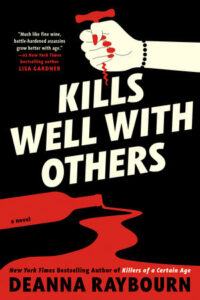
 Berkley
Published March 4, 2025
Reviewed by Mary-Jane Oltarzewski
Billie, Mary Alice, Natalie and Helen are an elite squad of assassins who are Boomers in every sense of the word: they are in their early ‘60s, and wherever they go, things are likely to go boom. Helen is a Special-Ops level sharpshooter, and Billie has been known to start some fairly major conflagrations using little more than a book of matches, a bag of corn chips, and some non-dairy creamer (who knew it was so flammable?)
Kills Well With Others is the second of Raybourn’s fun, smart, fast-paced novels about these four kick-ass assassins who are just too good at their jobs to settle down and retire. Decades ago, they were recruited and trained by a super-secret spy organization known euphemistically as The Museum, whose original mission was to find and assassinate Nazi war criminals who had evaded more conventional means of justice (“If looted art managed to get recovered at the same time, it was a bonus”). Over the years, as fewer of these criminals survived, The Museum broadened its goals to include the elimination of arms dealers, human traffickers, ruthless dictators, and warlords from across the globe. None had ever been apprehended or tried in any court of law, but they all had it coming, often at the skilled, stealthy, stylishly-manicured hands of this fierce foursome.
Much of the fun in this novel arises out of the clever resilience that has kept these four at the top of their form over the years. They are masters of disguise, who have managed to pass for prim British nannies, Playboy Bunnies, bumbling tourists, nuns, and at one point, “ a proper Montenegrin grandma” sporting layers of peasant skirts, cardigans, headscarves and a live chicken. They can kill, or defend themselves efficiently, not just with guns, knives, or a variety of poisons, but any number of household items such as a corkscrew, or a garrote that doubles as a chic strand of beads. They are not getting any younger, and it takes longer than it once did, to recover from a firefight or a bloody hand-to-hand battle, but their combined experience is formidable, and their wits are quicker than ever. They know when it’s important to fortify their bodies with a few hours’ rest, a decent meal, and the occasional unprescribed medication. Most importantly, they can rely on one another under the most deadly and dire circumstances: they bicker like teenagers, but also trust one another with their lives, with a relentless loyalty that has developed from working, fighting, and taking harrowing risks together, for the past forty years.
This time around, they’ve been called in to tie up some dangerous loose ends related to the Lazarovs, a brother and sister from Russia by way of Bulgaria, who have “underworld connections, experience in dealing with art if you weren’t too fussy about the provenance, and who didn’t mind getting their hands bloody.’” The siblings were orphaned when the Museum eliminated their father – a vicious, violent gangster – back in the 1980’s, and they’ve already murdered two agents who participated in that mission. No one involved is safe, until the squad eliminates them both.
The assignment takes them from Colonial Williamsburg, to a “business” trip on the Queen Mary 2, to Greece, Switzerland, and Venice, en route to an action-packed climax that takes place on a rickety train, high above the Balkan coast. Along the way, it combines the suspense of a Hitchcock movie with a funny, touching reflection on the restorative powers of friendship, pet ownership (rest assured, the chicken comes to no harm,) as well as excellent wine and food (Billie’s romantic interest, another semi-retired spy, is so proficient at cooking and killing that a lovestruck minor character describes him as a “stern brunch daddy,”) and sublimely beautiful art. Remember, if a priceless painting, missing since the 1940s, turns up – that’s a bonus!
With their mission completed, the surviving assassins are back in Venice, where they toast each other and their fallen comrades, at the Peggy Guggenheim Collection, in front of a stunning work of art that serves as a metaphor for women in their line of work. Leonor Fini’s Shepherdess of the Sphinxes portrays “a herd of sphinxes … with the torsos of beautiful women grafted onto the bodies of lionesses. They were wild in their ferocity, absolutely untamable … Some creatures are born to destroy.” This painting really exists, and it really hangs in that gallery in Venice. Look it up, and if you find it as dazzling as they do, this is surely the book for you.