
 Scribner
Published May 27, 2025
Reviewed by Mary-Jane Oltarzewski
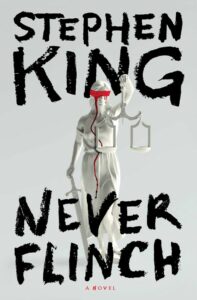
Holly Gibney, who first appeared in Mr. Mercedes (2014) has evolved from a nervous, insecure supporting character to a highly regarded private detective, the protagonist of Stephen King’s latest novel, Never Flinch. Described by a friend as “Sherlock Holmes in low heels, pastel blouses and tweed skirts,” Holly is petite, socially awkward, and struggles with obsessive-compulsive disorder, but she’s exceptionally intelligent and intensely perceptive. Her eye for detail permits her to see around corners, and her sense of justice contributes to extraordinary resourcefulness and courage when the need arises. Despite her mousy appearance, she’s not to be underestimated: A big tough guy, telling Holly stories in a bar, explains “‘She’s got a lot of bells and whistles, but … she’s smooth.’” His companion concurs: “‘Also got a yard of guts.’”
Holly’s skill set catches the attention of Kate McKay, a women’s empowerment activist whose brash charisma creates controversy wherever she goes. While touring to promote her latest best seller, she has attracted the attention of an increasingly aggressive stalker, and hires Holly as a bodyguard. Kate is a true believer, a passionately committed feminist, but also a spotlight junkie with a giant ego. She’s brave to the point of reckless, and tends to treat her bodyguard and Corrie – her young, naïve but extremely competent assistant – as the hired help, even when that means endangering their safety. King does some great work here, portraying not gore, or horror, or crime, but the pressure that fame imposes, upon the celebrities who are addicted to it, the acolytes and detractors who are obsessed with them, and the unsung supporting cast, like Holly and Corrie, who seek to run interference behind the scenes.
As if Kate and her stalker aren’t enough of a challenge, Holly is also being unofficially consulted by her hometown police with regard to a serial killer who appears to be choosing victims at random, although each is found holding a note indicating the name of a juror who served on a recent, sensational trial. The defendant in that trial was convicted of possessing child pornography; after he was stabbed to death in prison, however, facts come to light that seem to prove he was an innocent man, framed by a jealous co-worker and railroaded by an ambitious prosecutor. The killer appears to be pursuing some warped sense of justice. Then again, maybe they’re just looking for reasons to kill, over and over again. They keep taunting the police with letters signed “Bill Wilson,” as in the founder of Alcoholics Anonymous; this person seems to understand, and maybe even celebrate, addictive behavior.
In less skillful hands, it would be impossible to see how these two plots are related, but they are: loosely, at first, with only Holly’s peculiar diligence to connect them, but the threads pull together more and more tightly as the story comes to an (almost) heart-stopping conclusion. Stephen King has written more than 60 books; many are iconic examples of the horror genre. But if he had only ever written the Holly Gibney novels, those books would still comprise an outstanding contribution to American fiction.