
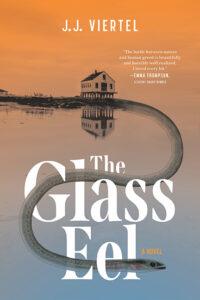
 Penzler / Mysterious Press
Published September 9, 2025
Reviewed by Barbara Fister
The glass eel is a curious creature. Born in the Sargasso Sea, it makes its way as a tiny, translucent fingerling, joining vast schools of eels to ride ocean currents to the coast of Maine. There it travels up streams to live in freshwater before returning as an adult to the Caribbean to start another generation. For years they were of little interest to American palettes, but a shortage in Asia led to a boom in export prices. A Maine fisherman can earn over two thousand dollars a pound for the voluminous, yet now endangered eels. It’s the competition for this bounty that powers the plot of this novel. Some licensed exporters are willing to pay bribes to dodgy political figures to relax regulations; some without licenses are willing to resort to violence to protect their secret trade. And into the middle of it all Jeanette King finds herself entangled in the slippery, slimy business.
Jeanette lives on a remote island that’s only just beginning to become a vacation spot for outsiders. Most of the residents are working class: “If a job wasn’t in the Bible–fisherman, carpenter, farmer–it wasn’t really a job.” She lives, like most folks in her community, a hardscrabble life. She has a small business employing a few women who help her “pick crabs,” filling containers with crab meat to sell to restaurants, but on weekends she cuts hair at salon and picks up other odd jobs, struggling to pay the bills after her divorce from Simon, a lobsterman, a relationship that fell apart after their son drowned.
One morning, too early for lobster pots to be ready to pull, she notices a boat circling in the water just past her dock. When she takes her dinghy out to investigate she realizes it’s the Jeanette, her ex-husband’s lobster boat, its live well full of squirming, slithering baby eels, but with nobody else aboard. She’s hailed by a young acquaintance who arrives by boat and assumes she’s there for the same purpose as her ex. He hands her a pouch filled with over eight thousand dollars.
What has Simon been up to, and what should she do with the money? The answers grow more complicated when she’s threatened by a stranger who demands the money – more than was in the pouch. Jeanette is not easy to intimidate. Aided by a sympathetic cop, along with an odd environmentalist who is determined to protect native ways against modern life and an employee who is an enrolled Passamoquoddy Indian, she figures out who the players are and how her ex got involved in a valuable trade she knew nothing about but which, before long, leads to a murder she is determined to solve.
This is a splendid debut, with deeply realized characters and a vividly rendered setting in which the well-paced plot unspools with many a jolt and a surprise. Perhaps the most striking sections of the novel are those that take us underwater, to see the world from the perspective of a crab, a lobster, and an eel. Far from a cutesy anthropomorphic conceit, this is well-observed nature writing that enhances the reader’s full understanding of the world the author is building.
And as a bonus for those who came for the thrills, there’s an unforgettable and highly original method for disposing of a body.