
 Minotaur
Published October 14, 2025
Reviewed by Mary-Jane Oltarzewski
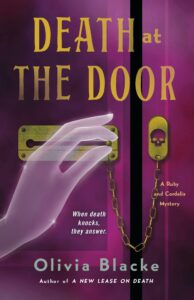
For a story about the ghost of a hard-drinking woman who died – maybe by suicide, maybe by murder – investigating a homicide committed on her old mortal turf, Olivia Blacke’s Death at the Door is a fun, breezy read. Actually, the ghost of Cordelia Graves is only half of the team investigating the killing; her partner in this endeavor is Ruby Young, a sweet-natured 20-year old who lives in the apartment that was vacated (physically, at least) when Cordelia died under questionable circumstances shortly before Ruby arrived in Boston in the wake of a bad breakup, looking for a job and place to live. The two amateur detectives, one mortal and one spectral, hit it off in Blacke’s earlier Ruby/Cordelia novel, when they joined forces to solve the murder of their neighbor from across the hall.
Not everyone can see, or even sense, Cordelia’s spirit, even when objects start levitating and electrical devices suddenly begin to short circuit, but Ruby believes in ghosts and has always wanted to meet one, so she accepts her “roommate” with the same enthusiastic curiosity that characterizes all of her endeavors. Cordelia, having gotten over Ruby’s relentlessly cheery temperament and tendency to kill all the beautiful houseplants left behind in the apartment, has developed a protective affection towards her: “’I’d grown to like the kid. A lot. She had a good heart. Plus, unlike mine, her heart was actually beating, which came in handy sometimes.’” She even managed to find Ruby a job by guiding her to the IT firm that needed a new receptionist, after Cordelia’s demise.
This workplace is where the unlikely besties encounter the latest murder. Marty, the deli delivery guy – cute, likeable, and known to deliver not only sandwiches and breakfast platters, but the occasional controlled substance – has dropped dead in the office’s restroom. At first it looks like an overdose, but Ruby, and even more so Cordelia, know better. Everyone in the office is under suspicion, as are the visitors from a competing tech firm, who include Ruby’s handsome new neighbor, Tosh, who’s either a potential love interest, a corporate spy, or possibly both.
As in the last outing, the perfectly serviceable whodunnit plot matters less than the way these two combine their complementary skills in order to get to the bottom of things. “’If Cordelia and I had ever crossed paths in life, we wouldn’t have had anything in common,’” Ruby muses, “’I doubt we would have clicked. But it didn’t matter. because our paths did eventually cross, and we had learned how to get along.’” When Ruby speaks, Cordelia can hear her, but in order to respond she relies on her ability to defy the laws of physics by moving solid objects. She’s teaching her mortal sidekick to cook by flipping open cookbooks and placing groceries into her cart, and sends rudimentary messages using an old Etch-a-Sketch and one of those magnetic poetry sets stuck to the side of the refrigerator.
The friendship has evolved into something weirdly sweet. Cordelia, who’s beyond mortal harm, is dedicated to keeping Ruby healthy and safe; she has even been known to pick the occasional pocket, if Ruby is short on cash and the wallet owner is rude and has it coming. Ruby is just as dedicated to finding out what actually happened to Cordelia, as facts come to light, seeming to indicate that her death was no more a suicide than Marty’s was. Marty’s murder is resolved neatly, but the novel ends with a cliffhanger that hints at further intrigue. It’s a clever conclusion that will encourage readers to stay tuned for another installment involving corruption at the workplace, the return of Cordelia’s reckless younger brother, the impending marriage of Ruby’s bridezilla sister, and more excitement and humor involving the death and immortal life of Cordelia Graves.