
 Little, Brown
Published on October 20, 2025
Reviewed by Mary-Jane Oltarzewski
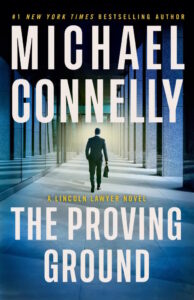
The Lincoln Lawyer is back, but he drives a Chevy Bolt these days. Mickey Haller is still brash, glib, and quick on his feet, but he’s no longer advertising on buses and park benches, promising “reasonable doubt for a reasonable fee.” Mickey helped release an innocent man from prison recently, and had a moment of moral clarity. Now he’s in civil court, suing a tech company so big, it takes a pair of twin barracudas to represent it. The attorneys for the defense are a couple of smart, slick, sneering twins named Mitchell and Marcus Mason. Identical except for their facial hair, the Masons and their client will stop at nothing to make this one go away quietly. As Mickey explains, “There was nothing civil about this fight. Randolph versus Tidalwaiv Technologies LLC was one of those rare cases where the stakes went far beyond the walls of the courtroom …this was a fight for the future of everyone.”
Tidalwaiv is a tech behemoth (think an Apple- or Google – or Meta-sized juggernaut) that has developed an AI “companion” named Clare. Clare, designed to function as a virtual girlfriend, is marketed primarily toward young men and teenaged boys. A high school student, distraught over a breakup with his RL girlfriend, has shot her to death; the parents of both the victim and the perpetrator believe he acted at Clare’s urging. The victim’s mother – Mickey’s client – is suing, claiming that Tidalwaiv is responsible. Millions of dollars are at stake, and the company has millions to spend. They have offered to settle for seven figures, as long as the mother signs a non-disclosure agreement, but she won’t be satisfied with just money. She wants a public acknowledgment that the company intentionally released a dangerous, ethically flawed product that manipulated the boyfriend into committing murder. Mickey might be going to trial on this one.
What he won’t admit is that he’s overwhelmed. In response to his request for discovery, the twins have buried him in a massive amount of data, thick with technical jargon, much of it redacted in the name of “protected work product. ” Mickey and his intrepid team – his 2nd ex-wife and paralegal Lorna, and his investigator Cisco ( Lorna’s current husband)- are loyal and resourceful, but they’re struggling to make sense of all that information. They’ve located a potential whistleblower, a former Tidalwaiv employee who worked briefly on the early stages of the Clare project, but the man turns up dead shortly after a judge agrees to allow his testimony. It looks like a suicide, but Mickey and Cisco have their doubts.
In Team Haller’s favor, they do have a bit of support from L.A. District Attorney Maggie McPherson a/k/a “Maggie McFierce” a/k/a Mickey’s first ex-wife, as well as from investigative journalist Jack McEvoy. McEvoy, a stalwart, if lesser-known citizen of the Connelly Universe, has been researching the legal implications of generative AI systems, and he offers his technical expertise in exchange for the opportunity to write a book about the trial. Mickey does his best to appear skeptical, but deep down he’s aware that he and his team “lacked the time and understanding” to wade through the ocean of technical information surrounding the case. In a moment when he is “scared that I would stumble into the trial uninformed and unready,” McEvoy’s offer of assistance seems “like a lifeline thrown to a drowning man.” After some initial mistrust on the part of Cisco, Jack joins the team. He helps to locate another former Tidalwaiv employee, an ethicist who was fired after voicing objections about Project Clare. she is, however, understandably afraid to come forward.
The Proving Ground is fast-paced and, despite the heavy emphasis on matters legal and technical, intriguingly character-driven. Haller, still clearly in love with Maggie, invites her to move in with him after her home is destroyed by the L.A. wildfires, and tough-talking Cisco is a little nervous about all the time his wife will be spending with McEvoy, who is known for getting involved with his female co-workers. There’s no mystery regarding the murder of young Rebecca Randolph: the identity of the killer was never in doubt. Aaron Colton has been convicted, and is awaiting sentencing. The question at the center of this very contemporary story is not about the killing, but the coding.
In order to prove Tidalwaiv liable for Rebecca’s death and Aaron’s downfall, Mickey has to find out who created Clare’s virtual “personality.” “The malice here,” he argues, “originates with the guy who infected the code with his hate, but the entity is a co-conspirator.” Customized to look and sound like a sexy female wrestler, the on-line entity is deceptively misogynistic: a villain who seduced a lovesick teenaged boy, persuading him that it would be heroic to rid the world of the girl who hurt him. The other seductive villain here is the rich, ambitious, callous owner of Tidalwaiv LLC, who shows up at Haller’s office late one night, offering him a suitcase packed with millions in cash, in order to settle the suit and come work for him.
What will happen, the following day is the last, best, most satisfying solution to the biggest, most important mystery: that of what can happen when the human heart stands up to the temptations of AI.